


· Nathalie
How Much Water Should You Drink on a Hike? A Practical Hydration Guide
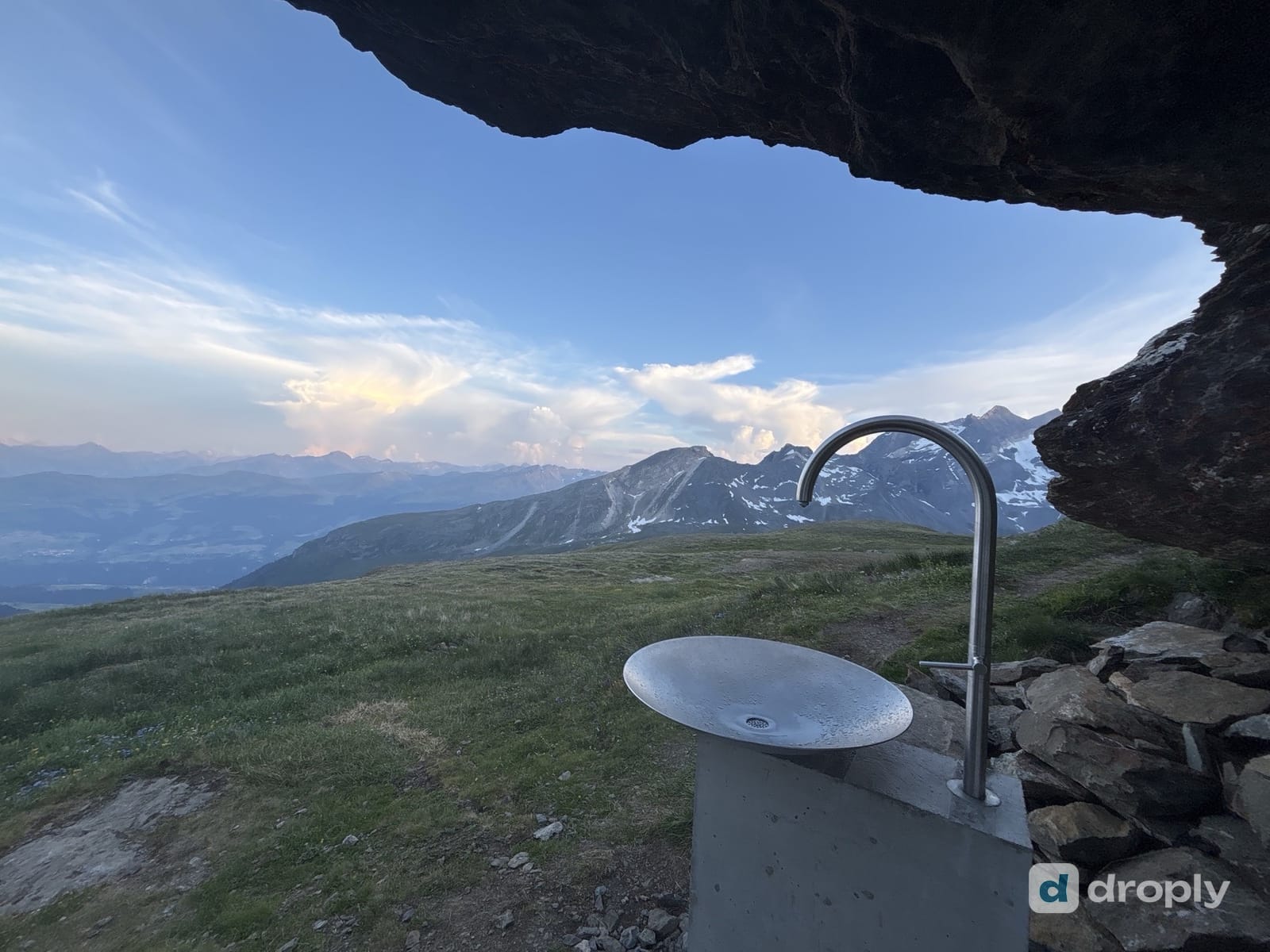
Not a fixed number of liters per hour. What your fluid needs actually depend on, why drinking too much is its own danger, and how knowing your refill points changes how much you carry.
How much water you should drink on a hike is not a fixed number of liters per hour. It’s however much your thirst tells you to drink, in the conditions you’re actually walking in.
That answer is less satisfying than “one liter every two hours”, and it is the one the evidence supports. The Wilderness Medical Society’s clinical practice guidelines recommend drinking to thirst during exertion, and note that no specific fluid volume has been shown to prevent the main overdrinking risk.
There’s a second question hidden inside the first, and it’s the one that changes your pack weight. How much you drink and how much you carry are not the same thing. If you know where the next reliable water source is, you can carry a lot less of it.
How much water do you actually need on a hike?
Enough that you’re not thirsty, and no more. Fluid needs vary too much between people and days for a universal number to be useful.
As a rough planning estimate, many adults drink somewhere around 0.4 to 0.8 liters per hour of moderate hiking. Treat that as a range to plan around, not a target to hit. On a short cool walk, drinking very little is completely normal. On a long climb in August heat, losses can be much higher than the top of that range.
What actually moves the number: body size, sweat rate, pace, how much you climb, temperature, humidity, sun, wind, what you’re wearing, how heavy your pack is, how well you’re acclimatized to heat, and how long you’re out. Distance is near the bottom of that list. Twelve kilometers flat along a shaded river is a different day from 12 km up an exposed south-facing slope, and your bottle knows it.
Summary: There is no correct liters-per-hour figure. Plan around 0.4 to 0.8 L/h in moderate conditions, then let thirst and the conditions decide the rest.
Does the weather change how much water you need?
Yes, more than distance does. Heat, humidity and direct sun together determine how hard your body has to work to stay cool, which is why temperature alone tells you very little.
| Conditions | Expected fluid demand | How to plan |
|---|---|---|
| Cool, easy terrain | Low | Drink to thirst, no special planning |
| Mild | Moderate | Drink as needed |
| Hot and sunny | High | Check refill points before you go |
| Hot and humid | High | Sweat evaporates poorly, so cooling is worse at the same temperature |
| Strong wind | Variable | Sweat dries fast, so you notice the loss less |
| Cold | Variable | Thirst is blunted, and you still lose water through breathing |
| High altitude | Often higher | More exertion, more respiratory loss |
| Steep climbing | Higher | Sustained effort, more sweat |
The WMS heat illness guidelines, updated in 2024, use wet-bulb globe temperature as the preferred measure of heat stress, precisely because it combines temperature, humidity and solar radiation into one number. Air temperature on its own misses two thirds of the picture. Those guidelines also make the acclimatization point: 1 to 2 hours a day of exertion in the heat for at least 7 days gets you most of the way to adapted, which is why the first hot day of the year feels so much worse than the tenth.
Summary: Plan around heat, humidity, sun and climbing, not kilometers. The same route needs very different water in June and in October.
Should you drink a lot of water before you start?
No. Start normally hydrated, not overhydrated.
There’s a persistent idea that you can load up before a walk and bank the water for later. You can’t. Your kidneys deal with the excess, and what you gain is a full stomach for the first hour. If you’re thirsty at the trailhead, drink. If you’re not, don’t force it.
This matters more than it sounds. The WMS guidelines identify excessive fluid consumption immediately before, during or shortly after exercise as a contributor to exercise-associated hyponatremia. Pre-loading is one of the ways people get there without realizing.
Summary: Eat and drink normally before you go. There is no water reserve to build up, and forcing it adds risk rather than protection.
How often should you drink while you’re walking?
When you’re thirsty. Beyond that, whether you take small sips continuously or stop for a proper drink every 45 to 60 minutes is a question of convenience, not physiology.
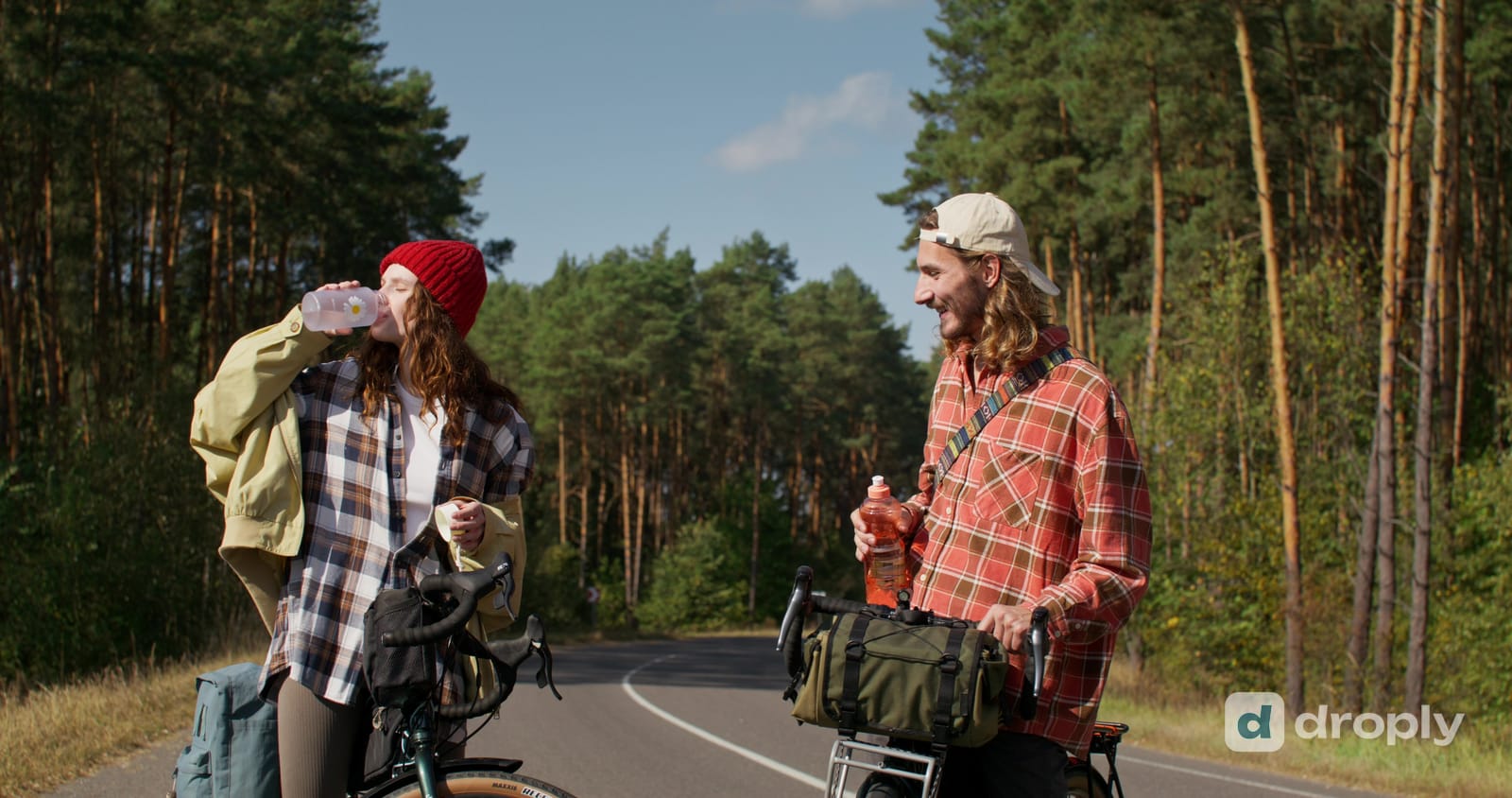 A drinking break is a practical habit, not a physiological rule. What matters is your total intake, not the interval.
Thirst is a better guide than most people expect. In a 2021 study of exercise in the heat, thirst perception rose reliably as dehydration progressed, and it did so whether or not participants were given accurate information about their own fluid losses. The signal tracked the actual physiological state, not what people believed about it.
Rigid schedules can even work against you. In a 2016 double-blind treadmill study of 20 college students, the group drinking voluntarily performed better, lasting longer and running faster, than the group made to drink 900 ml on a fixed 15-minute schedule. The researchers put it down to gastric distention from drinking more than the body was asking for.
So a deliberate stop every hour is a fine habit if it suits you. What it isn’t is physiologically superior to drinking when you feel like it.
Summary: Drink when you’re thirsty. Regular drinking breaks are a convenient routine, not a rule, and a forced schedule can be worse than none.
Is a hydration bladder worse than a bottle?
Not physiologically. A tube and bite valve deliver water to your body exactly as well as a bottle does, and having water reachable without stopping is genuinely useful on technical ground.
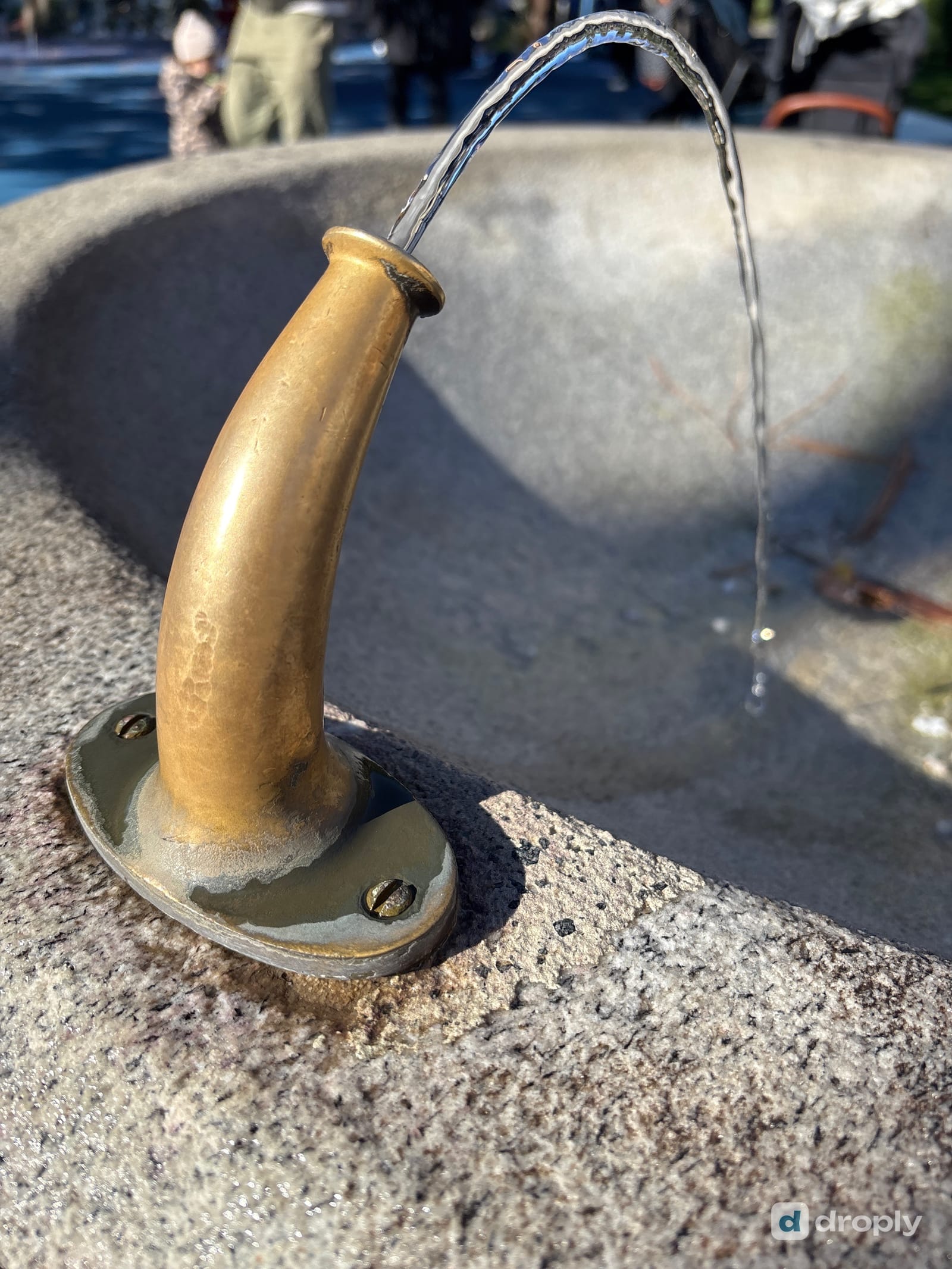 Fountain in Muralto, near Locarno in Ticino, Switzerland. Whatever you drink from, what goes into it is the same water.
The real difference is behavioral. A bite valve at your shoulder makes it very easy to sip without ever deciding to, and without any sense of how much you’ve drunk. A bladder also hides the level, so people often discover the problem at both ends of the range: half empty when they thought it was full, or two liters gone with no memory of drinking them.
If you tend to sip out of habit rather than thirst, a bottle helps, because you can see what’s left and each drink is a small decision. If you tend to put off drinking because stopping is annoying, a bladder helps. Pick for how you actually behave, not for what the gear reviews say.
Summary: Neither is better for hydration. A bladder makes drinking easy and unconscious, a bottle makes it visible and deliberate. Choose the failure mode you don’t have.
Can you drink too much water on a hike?
Yes, and this is the part most hiking advice leaves out. Drinking more fluid than your body can excrete dilutes the sodium in your blood, and the result is exercise-associated hyponatremia, defined as a blood sodium concentration below 135 mmol/L.
The mechanism is straightforward. You lose both water and sodium in sweat. You keep drinking, mostly water. Intake exceeds what your kidneys can clear, blood sodium falls, and water moves into cells, including cells in the brain. Severe cases involve cerebral edema.
What makes it dangerous on trail is that the early symptoms read as ordinary tiredness or dehydration:
- headache
- nausea and vomiting
- bloating, or rings and shoes feeling tight
- weakness and fatigue
- confusion and altered mental status
- in severe cases, seizures and coma
The American Academy of Family Physicians summary of the WMS guidance is direct about the main risk factor: prolonged overconsumption of fluid. It’s not a rare-athlete problem either. It has been documented in hikers, including in the Grand Canyon, not just in marathon runners.
The reason this matters for a hydration article is the reflex it breaks. Feeling bad on a hike does not automatically mean “drink more”. If you’ve been drinking steadily for hours, feel bloated and have a headache, more water can be exactly the wrong response.
Safety: Hydration goes wrong in both directions. Too little contributes to heat illness and dehydration. Too much can cause exercise-associated hyponatremia, a potentially life-threatening drop in blood sodium. If someone develops confusion, repeated vomiting, altered mental status, seizures or collapse, stop the activity and get medical help. This article is general information, not individual medical advice.
Summary: Overdrinking is a real and occasionally fatal risk, not a theoretical one. Prolonged excess fluid intake is the main cause, and the early symptoms look like dehydration.
Do electrolytes help?
Sometimes, and they’re not magic. Electrolytes, mostly sodium, are involved in fluid balance, nerve signalling and muscle function, so replacing some of what you sweat out has a role on long, hot days.
They become worth thinking about when you’re out for many hours, sweating heavily, walking in real heat, or doing something genuinely long and hard. For a normal two- or three-hour walk in normal weather, if you’re eating normally, a dedicated electrolyte product is usually unnecessary. Salty food does the same job.
The important part is what they don’t do. Electrolytes don’t make water “more hydrating”, and above all they don’t make overdrinking safe. The WMS guidance is explicit that sodium supplementation doesn’t prevent exercise-associated hyponatremia, and that electrolyte-containing drinks consumed in excess still dilute blood sodium. A sports drink is mostly water, and your body treats it accordingly.
Summary: Useful on long, hot, sweaty days, unnecessary on a short walk, and never a licence to drink more than you need.
How much water should you carry?
Enough for the longest stretch without a reliable refill, plus a reserve. Not enough for the whole day.
This is the calculation that actually changes your pack, and most people do it wrong by starting from total duration. Work it the other way around:
- Estimate what you’ll drink per hour in the expected conditions.
- Find the longest gap between reliable water sources on your route.
- Carry that gap’s worth, plus a reserve for the day being hotter, slower or longer than planned.
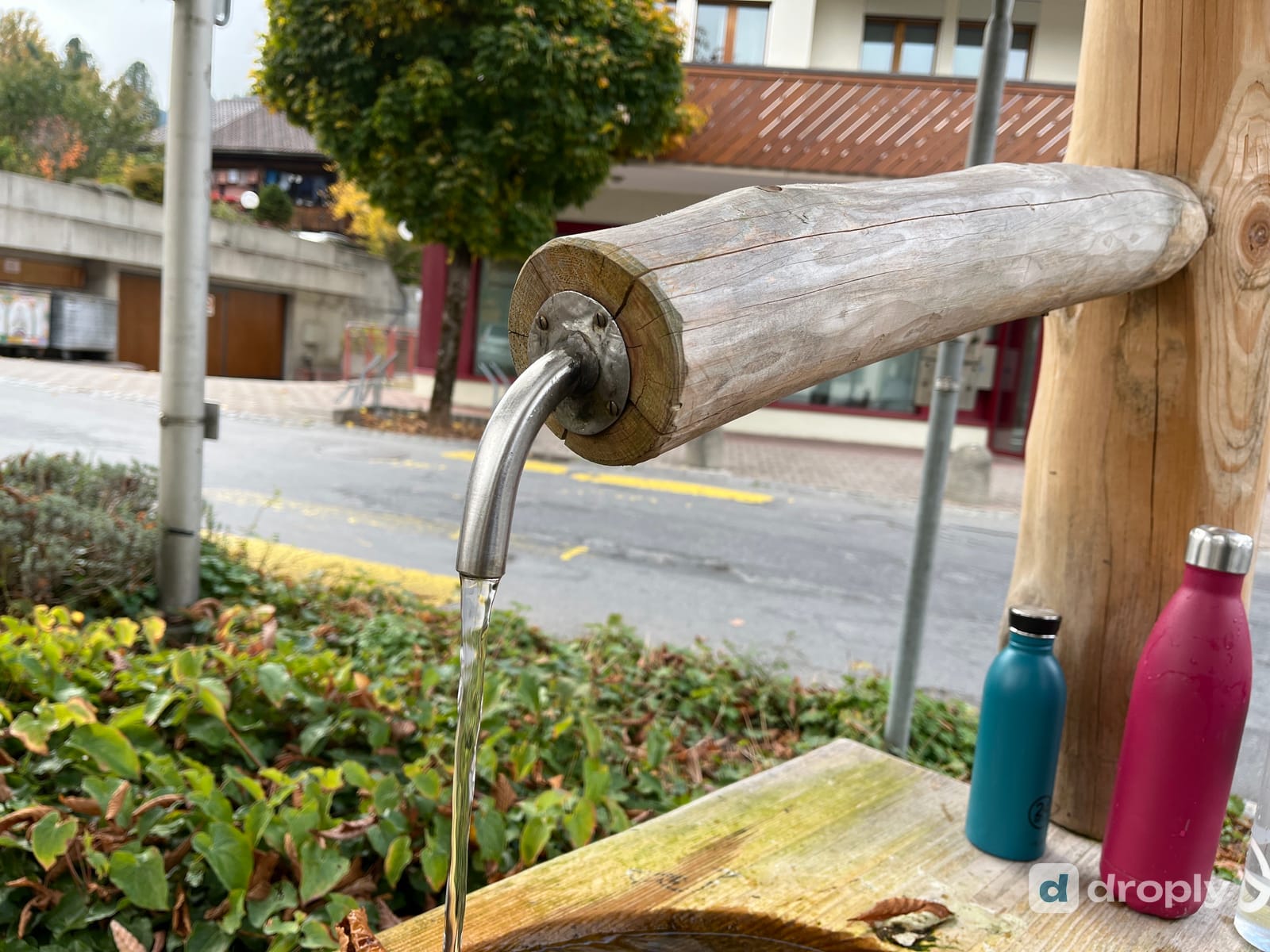 The Mätteli-Brunnen in Mannried near Zweisimmen, Bernese Oberland, Switzerland. Two bottles, one known refill point, and several kilograms you don’t carry.
A worked example. Six hours of walking at roughly 0.5 liters an hour is about 3 liters of drinking. Carrying all 3 liters from the start costs you 3 kg. But if there’s a dependable source at the halfway point, the longest dry stretch is 3 hours, so you need about 1.5 liters plus a reserve. Call it 2 liters. You’ve just saved a kilo, and you can drink the same amount.
The condition attached to that saving is the word “reliable”. A seasonal spring in late August, or a fountain that has been switched off, turns a clever plan into a problem. This is where knowing the state of a source, not just its position on a map, does the work. Our guide to water sources along the CDT goes deeper into planning around gaps on long routes, where a bad assumption costs a lot more than a kilo.
Summary: Carry for the longest gap plus a reserve, not for the total. Halving the longest dry stretch roughly halves the water on your back.
How droply fits into this
droply maps water sources and keeps their state current, so the gaps in your route are a known quantity before you leave. That’s the input the carry calculation above depends on.
Before you go, load your route and look at where the sources sit along it. What you’re looking for is not the total count but the pattern: where the long dry stretches are, and where you can plan to refill. The question stops being “how many liters do I need for this hike” and becomes “how much do I need between refill points”.
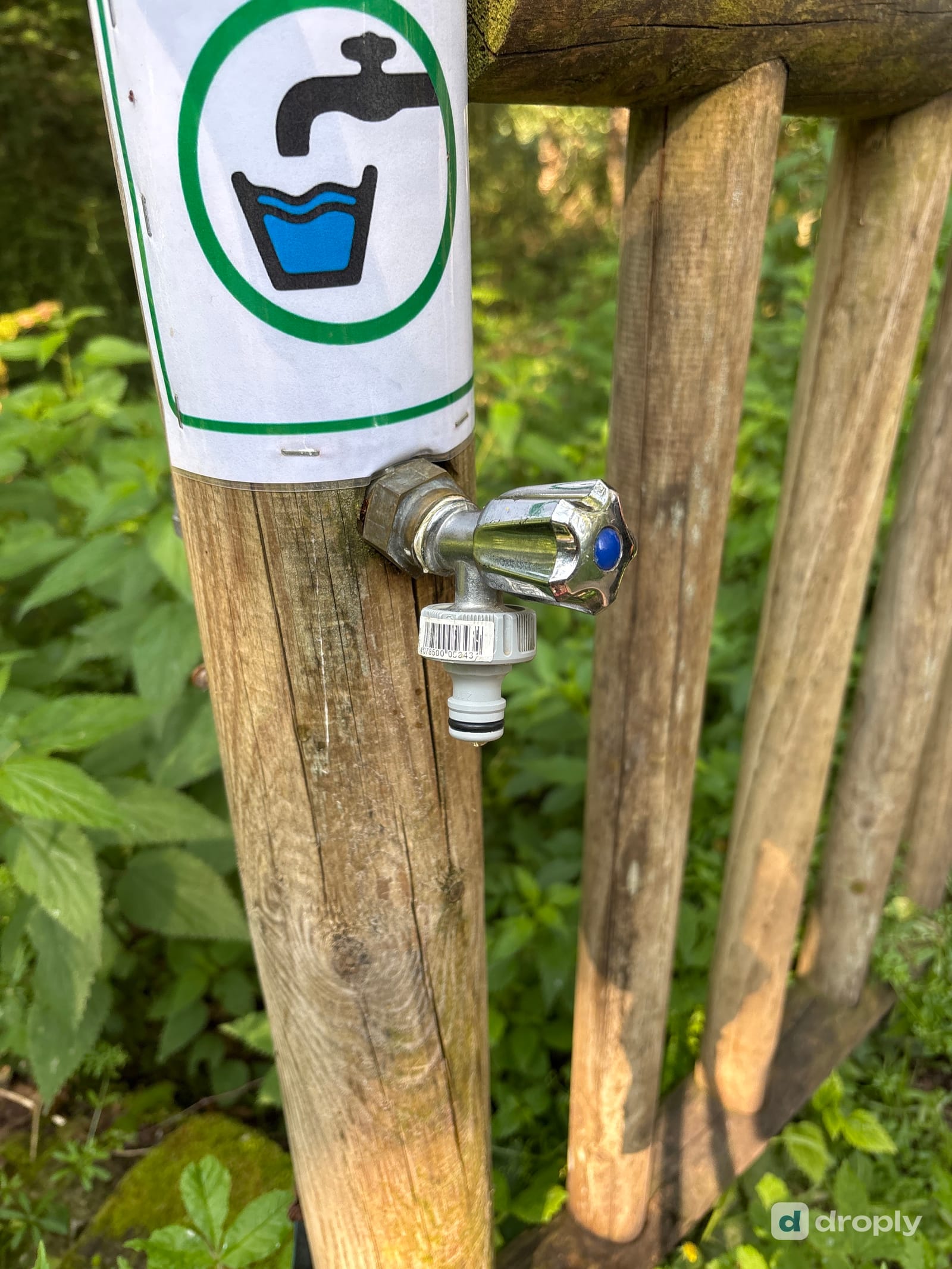 A signed drinking water tap near Golinhac in Aveyron, France, on the Via Podiensis. Somebody walked past this, noted it, and the people behind them didn’t have to guess.
On the walk itself, droply is for the moments the plan changed: it got hotter than forecast, the day is running longer, you extended the route, or you’re just lower than expected and want to know what’s ahead before a dry section. It works offline, which is the state most of these questions get asked in. If you carry other things on your phone for the trail, our round-up of hiking apps worth having installed covers what pairs well with it.
The sources are only current because people passing through say whether the water was running. One check-in is enough, and it means the next person doesn’t arrive at a dry tap.
Summary: Knowing where you can refill turns water from a fixed load into a planning variable. That is the whole argument.
Does this work in a city too?
Yes, and it’s the same problem in different shoes. A day walking around a city you don’t know can easily be 15 km on hot pavement with a bag on your back, and almost nobody plans water for it.
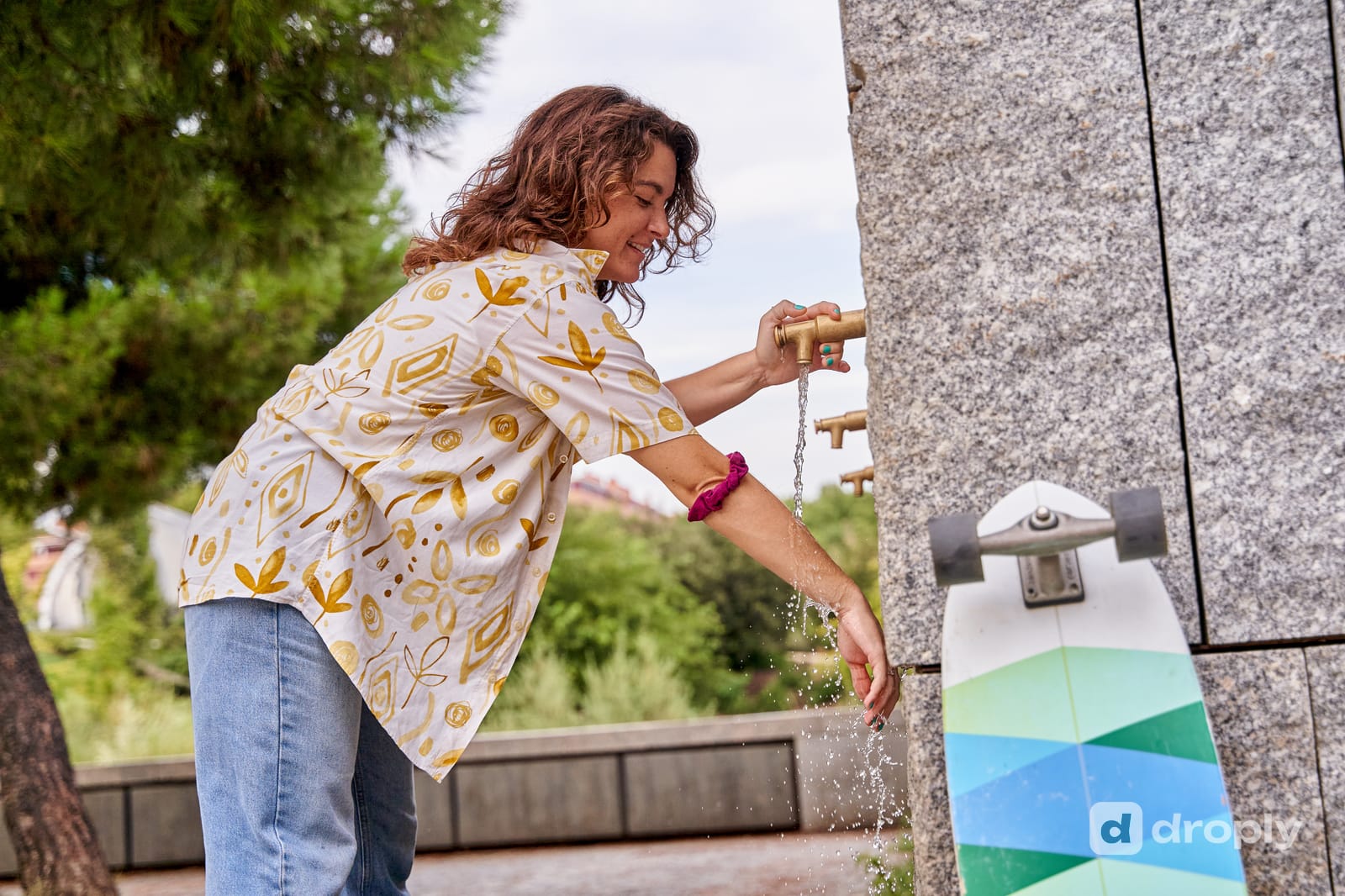 Same principle in town: knowing the next public fountain means one bottle instead of three bought ones.
Many cities have far more public drinking water than visitors realize, and finding it is the whole difficulty. Knowing where the next fountain is means carrying one bottle instead of buying three. Someone refilling on a city walk is doing exactly the same thing as someone on day 40 of a long trail, at a smaller scale.
Summary: Hot pavement and a full day of walking make the same demands as a trail. Refill points work the same way.
Can you catch up on water after the hike?
Partly. You can replace fluid losses afterwards, but deliberately running dry with the intention of fixing it later is a bad plan, because the cost lands during the walk, when you need to be functioning.
For normal recovery after a normal day: drink to thirst, keep drinking over the following hours rather than all at once, eat a normal meal, and include something salty if you’ve sweated a lot. Sodium with fluid helps you retain what you drink instead of passing it straight through.
Don’t force an enormous quantity of plain water the moment you get back. Substantial dehydration recovers over hours, not in one bottle, and a large volume of plain water taken quickly after exercise is one of the situations the hyponatremia guidance warns about.
Summary: Rehydrate gradually with food and salt, over hours. One giant post-hike bottle is neither necessary nor harmless.
Why do you get a headache while hiking?
Because a lot of different things cause headaches on trail, and dehydration is only one of them. Answering every hiking headache with a liter of water is a guess, and sometimes the wrong one.
The realistic list:
- Dehydration, usually alongside real thirst and a long stretch without drinking.
- Heat exhaustion. The WMS heat illness guidelines list weakness, fatigue, thirst, headache, nausea, dizziness and muscle aches as its presentation.
- Overdrinking. Headache is an early symptom of exercise-associated hyponatremia too, which is why the reflex matters.
- Altitude. Headache is the defining symptom of acute mountain sickness, and it shows up on ordinary alpine days, not just on expeditions.
- Not eating enough. Long effort on too little food produces headache and fatigue.
- Sun exposure, especially on a route with no shade.
- Caffeine withdrawal, if your normal two coffees became none.
- Exertion itself, and simple poor sleep the night before.
So the useful move is to look at the whole picture. How long since you ate. How much you’ve actually drunk. How much shade you’ve had. How high you are, and how fast you got there. Then respond to that, rather than to the assumption.
Summary: A hiking headache is not automatically dehydration. Check food, heat, altitude, sun and how much you’ve already drunk before adding more water.
Sometimes you find more than water in a fountain
Occasionally a water source turns out to hold something other than water. The best example we’ve come across sits above Elm in the canton of Glarus, Switzerland, at the end of the ELMER Citro Quellenweg.
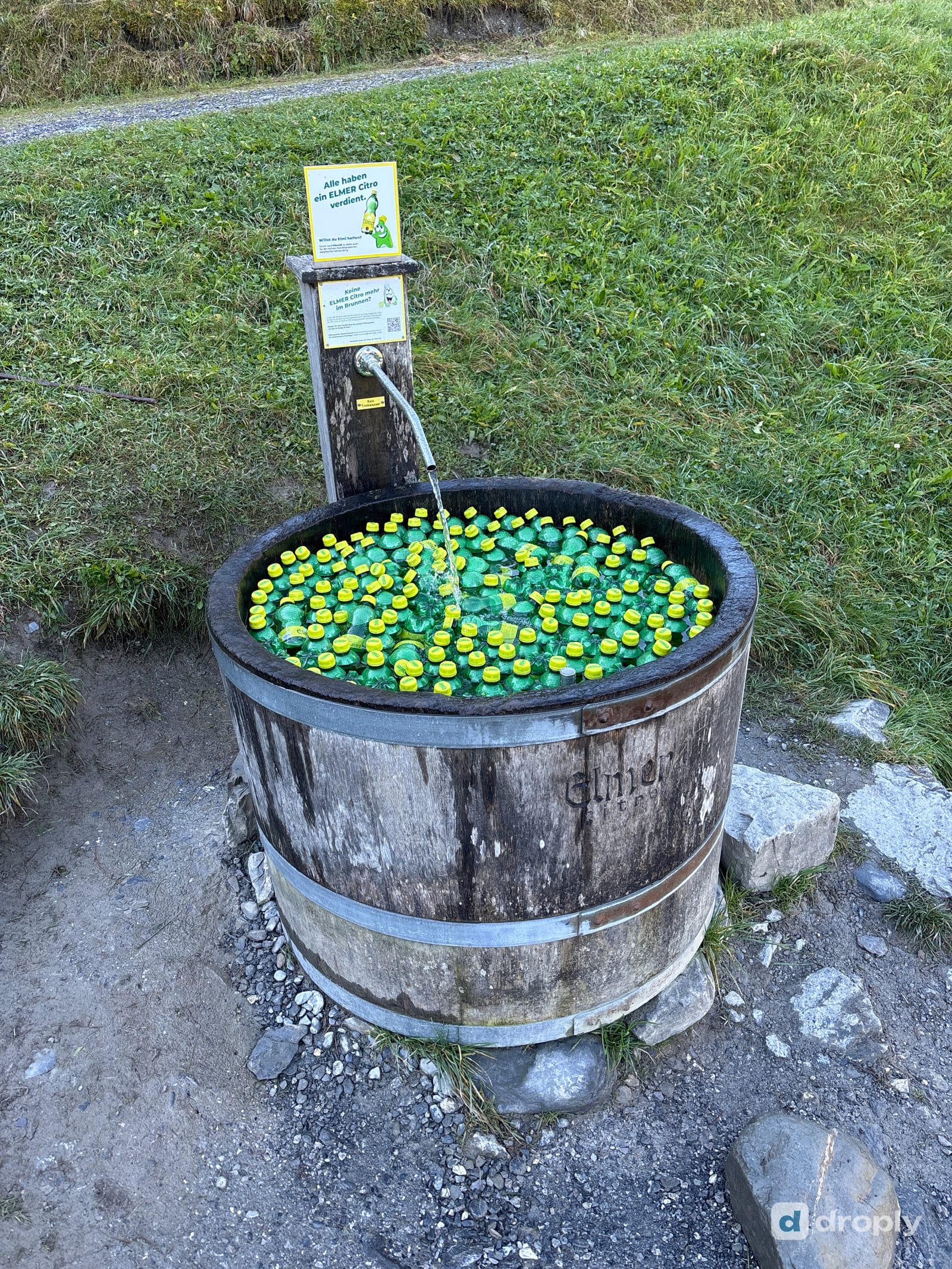 The Elmer Citro fountain above Elm, canton of Glarus, Switzerland. Spring water still runs into the trough, it just has company.
Elmer Citro is a Swiss lemonade made since 1927 with mineral water from a spring near Elm, and the village built a short walking trail around the springs that feed it. The Schweizer Wanderwege route description puts it at 4.4 km round trip with about 200 m of climbing, and five information panels on the way. At the top, the fountain is refilled with bottles of Citro on weekdays, cooling in the spring water, with a sign reading “Alle haben ein ELMER Citro verdient” and a QR code so walkers can report when the trough runs empty.
We’re not suggesting lemonade as a hydration strategy. It’s a good reminder that a water source is a real place with a history, and that the map is not the point. The point is what somebody actually finds when they get there.
Summary: A fountain is a place, not a data point. Sometimes it has bottles of lemonade in it.
A short checklist
Before you go
- Start normally hydrated. Don’t force a large volume before setting off.
- Check the forecast, particularly heat, humidity and sun.
- Look at where the water sources sit along your route.
- Find the longest stretch without a reliable refill.
While you walk
- Drink to thirst.
- Deliberate breaks are fine, forced schedules are not necessary.
- Constant sipping is not better hydration, it is just harder to track.
- Drink more when the heat and the climbing ask for it.
What to carry
- Estimate your consumption for the conditions.
- Carry the longest gap plus a reserve, not the whole day.
- Treat a source as reliable only if you have a reason to.
- Check the state of the sources ahead in droply, and leave a check-in for whoever comes next.
Afterwards
- Replace losses gradually over the following hours.
- Eat normally, and include something salty after heavy sweating.
- Don’t fix a hard day with one enormous bottle of plain water.
Frequently asked questions
How much water should I drink per hour of hiking?
There is no single correct number. As a planning estimate, many adults drink somewhere around 0.4 to 0.8 liters per hour in moderate conditions, but that is a range to plan around, not a target to hit. Wilderness medicine recommends drinking to thirst instead of a fixed hourly volume, because it adapts to heat, pace and your own physiology.
Should I drink a lot of water before starting a hike?
No. Start normally hydrated, which for most people means eating and drinking as usual and having something to drink if you are thirsty. Forcing large amounts of water right before you set off does not create a reserve. It mostly means walking with a full stomach, and drinking too much shortly before or during exercise is a risk factor for exercise-associated hyponatremia.
Can you drink too much water while hiking?
Yes. Drinking more fluid than your body can excrete dilutes blood sodium and causes exercise-associated hyponatremia, defined as a blood sodium concentration below 135 mmol/L. Symptoms include headache, nausea, bloating and confusion, and severe cases can lead to seizures and coma. Prolonged overconsumption of fluid is the main risk factor.
Do electrolyte drinks prevent hyponatremia?
No. Sports and electrolyte drinks are still mostly water, and drinking them in excess can dilute blood sodium just like plain water. Electrolytes are useful on long, hot, sweaty days, but they are not permission to drink more than you need.
Is a hydration bladder bad for you?
No. There is nothing physiologically wrong with drinking through a tube. The difference is behavioral: a bite valve at your shoulder makes it very easy to sip without noticing how much you have drunk. If that describes you, a bottle and deliberate drinking breaks make your intake easier to track.
How much water should I carry on a hike?
Carry enough for the longest stretch without a reliable refill, plus a reserve, not enough for the whole day. On a six-hour walk with a dependable water source at the halfway point, that is roughly half of what you would otherwise carry. Check the sources along your route before you leave, because a dry tap turns your plan into an emergency.
Why do I get a headache while hiking?
Dehydration is one cause, but not the only one. Heat exhaustion, altitude, not eating enough, sun exposure, exertion, poor sleep and caffeine withdrawal all produce headaches on trail, and so does drinking too much water. Look at the whole situation before you respond by drinking a liter.
Sources
- Bennett BL, Hew-Butler T, Rosner MH, Myers T, Lipman GS. Wilderness Medical Society Clinical Practice Guidelines for the Management of Exercise-Associated Hyponatremia: 2019 Update. Wilderness & Environmental Medicine, 2020.
- Eifling KP, Gaudio FG, Dumke C, et al. Wilderness Medical Society Clinical Practice Guidelines for the Prevention and Treatment of Heat Illness: 2024 Update. Wilderness & Environmental Medicine, 2024.
- American College of Sports Medicine. Exercise and Fluid Replacement, position stand.
- Backes TP, Fitzgerald K. Fluid consumption, exercise, and cognitive performance. Biology of Sport, 2016; 33(3): 291-296.
- Capitán-Jiménez C, Aragón-Vargas LF. Awareness of Fluid Losses Does Not Impact Thirst during Exercise in the Heat: A Double-Blind, Cross-Over Study. Nutrients, 2021.
Photos in this article were contributed by droply hikers: Breil/Brigels (Graubünden), Mannried near Zweisimmen (Bernese Oberland), Muralto near Locarno (Ticino), Elm (Glarus) and Golinhac (Aveyron, France).
Frequently asked questions
How much water should I drink per hour of hiking?
There is no single correct number. As a planning estimate, many adults drink somewhere around 0.4 to 0.8 liters per hour in moderate conditions, but that is a range to plan around, not a target to hit. Wilderness medicine recommends drinking to thirst instead of a fixed hourly volume, because it adapts to heat, pace and your own physiology.
Should I drink a lot of water before starting a hike?
No. Start normally hydrated, which for most people means eating and drinking as usual and having something to drink if you are thirsty. Forcing large amounts of water right before you set off does not create a reserve. It mostly means walking with a full stomach, and drinking too much shortly before or during exercise is a risk factor for exercise-associated hyponatremia.
Can you drink too much water while hiking?
Yes. Drinking more fluid than your body can excrete dilutes blood sodium and causes exercise-associated hyponatremia, defined as a blood sodium concentration below 135 mmol/L. Symptoms include headache, nausea, bloating and confusion, and severe cases can lead to seizures and coma. Prolonged overconsumption of fluid is the main risk factor.
Do electrolyte drinks prevent hyponatremia?
No. Sports and electrolyte drinks are still mostly water, and drinking them in excess can dilute blood sodium just like plain water. Electrolytes are useful on long, hot, sweaty days, but they are not permission to drink more than you need.
Is a hydration bladder bad for you?
No. There is nothing physiologically wrong with drinking through a tube. The difference is behavioral: a bite valve at your shoulder makes it very easy to sip without noticing how much you have drunk. If that describes you, a bottle and deliberate drinking breaks make your intake easier to track.
How much water should I carry on a hike?
Carry enough for the longest stretch without a reliable refill, plus a reserve, not enough for the whole day. On a six-hour walk with a dependable water source at the halfway point, that is roughly half of what you would otherwise carry. Check the sources along your route before you leave, because a dry tap turns your plan into an emergency.
Why do I get a headache while hiking?
Dehydration is one cause, but not the only one. Heat exhaustion, altitude, not eating enough, sun exposure, exertion, poor sleep and caffeine withdrawal all produce headaches on trail, and so does drinking too much water. Look at the whole situation before you respond by drinking a liter.
Published on
← Back to blog  By Nathalie · Co-Founder & Product Designer, droply
CDT (2024) & PCT (2018) thru-hiker · Co-founder & product designer, droply
Nathalie co-founded droply and designs its UI and UX. A passionate ultralight hiker who thru-hiked the CDT in 2024 and the PCT in 2018, she's always happy to carry less water, and to photograph a beautiful fountain along the way.
Get new posts in your reader
New guides and trail notes land in your feed reader the day they're published. No email address, no account, no tracking.
Feed address
https://droply-app.com/rss.xml