


· Micha
Drinking Water in Florence: Finding the City's Public Taps
Florence isn't an easy city for finding water: its public taps are real, but easy to miss among the crowds. Here's what they look like, where they hide, and the one spot in Piazza della Signoria worth remembering.
Florence isn’t an easy city to find water in. Unlike fountain-dense Bern or Zurich, Florence doesn’t advertise its public taps: they’re small, old, and built into walls and columns that compete for your attention with Renaissance facades, leather stalls and a few million other tourists a year. The taps exist, and the water is good. You just have to know where to look. droply was built by founders who got tired of exactly this problem on their own travels, so here’s where Florence actually keeps its drinking water, and the one spot worth remembering if every other tap has eluded you.
Why Florence is a tricky city for finding water
Florence’s historic center packs the Duomo, the Uffizi, Ponte Vecchio and Palazzo Vecchio into about a square kilometer, and most of the year that square kilometer is full of people. A small cast-iron tap at ankle height, tucked against a stone wall or a column, has no chance of competing with a gelato sign or a street performer for your attention.
The taps also don’t look like fountains the way Bern’s or Zurich’s do. There’s no figure on a column, no basin wide enough to spot from fifty meters. Most are a plain iron post with a single spout over a drain, easy to walk straight past even when you’re looking for one.
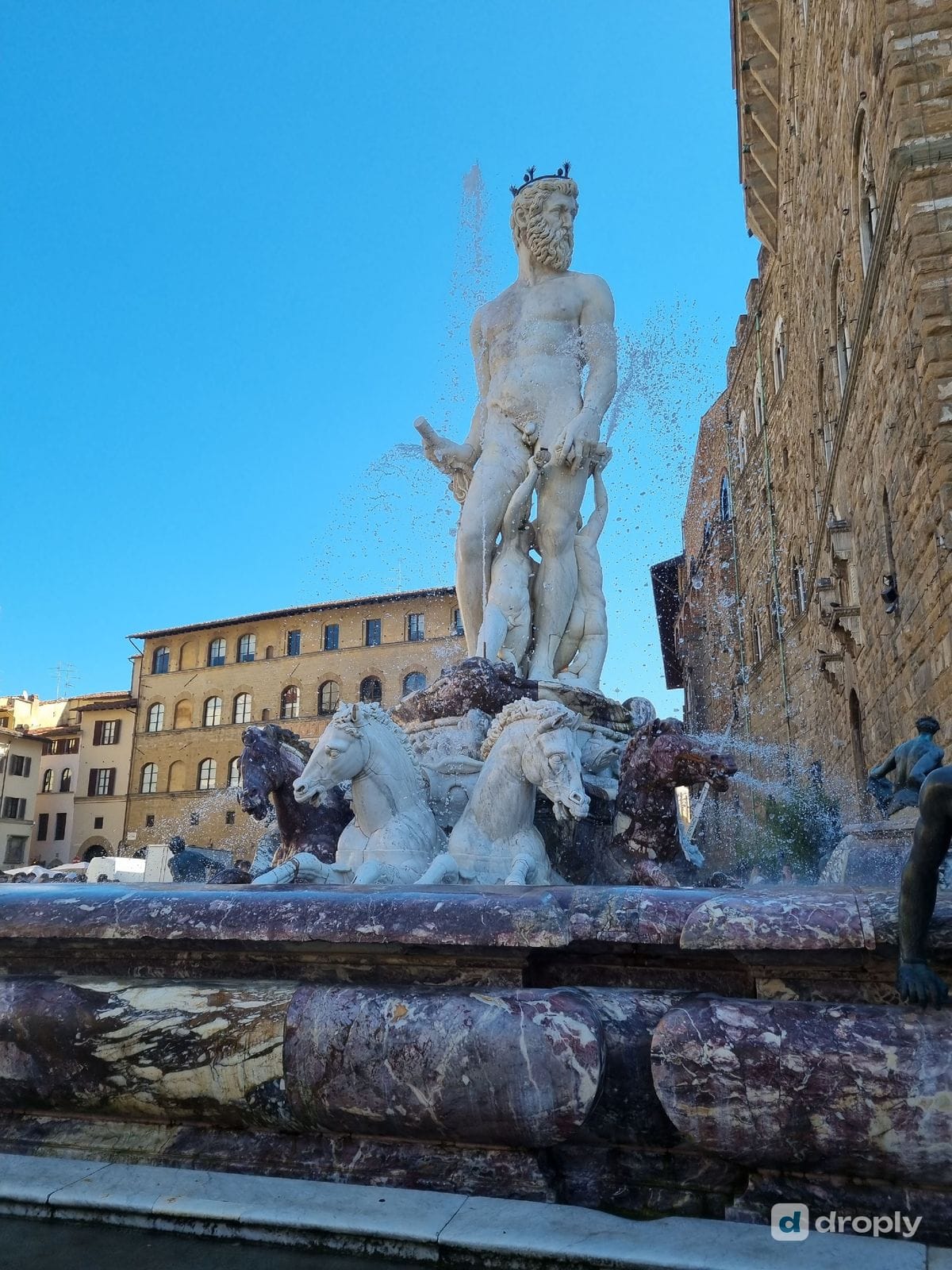
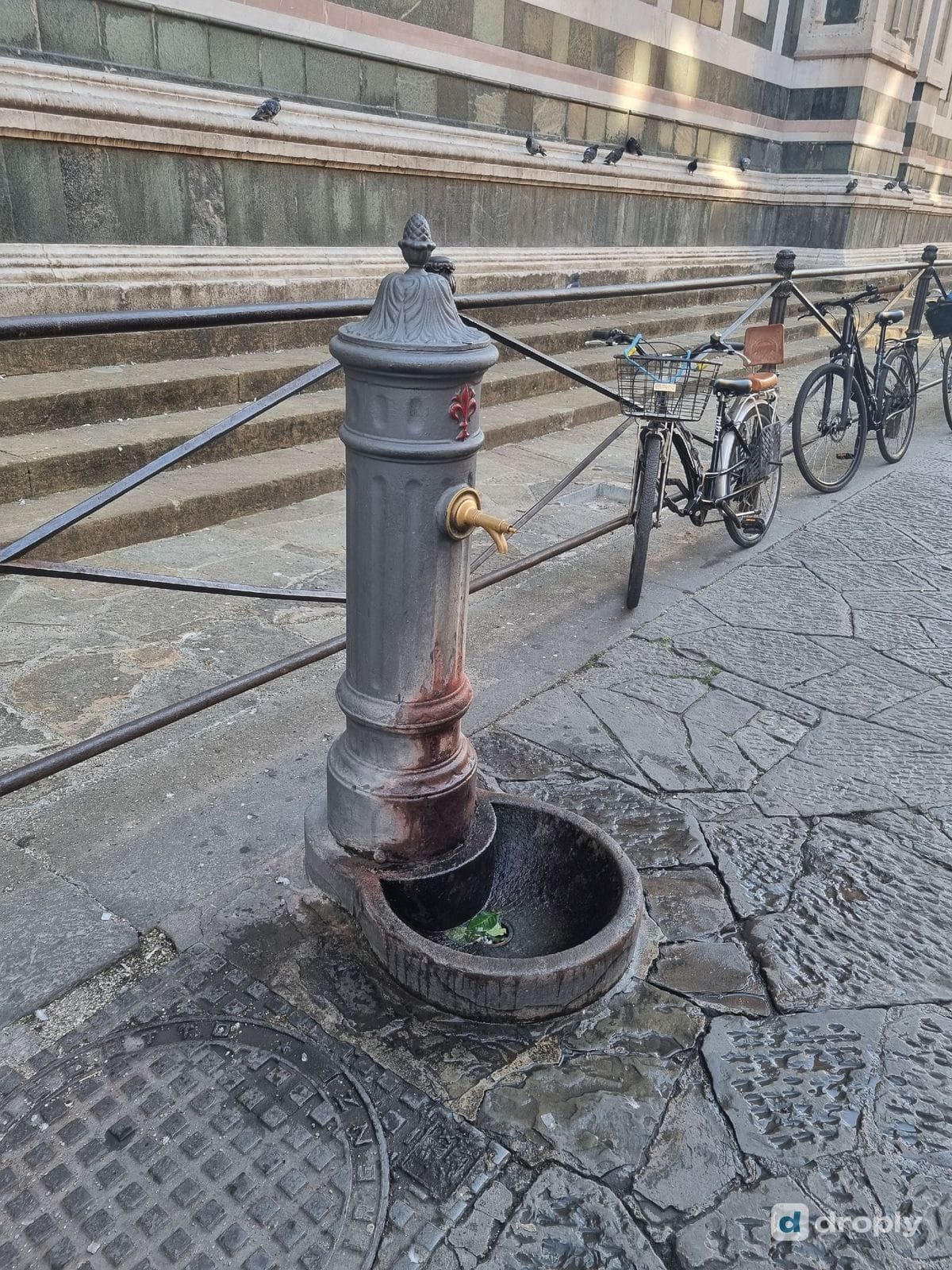
Status changes too, and not always for the better. The tap pictured below, on the Lungarno embankment, was running when it was photographed. It’s since been reported broken and is waiting on a repair from the city. That’s exactly why checking before you detour is worth the extra few seconds, and why droply depends on people reporting what they actually find: a tap that looks fine in an old photo can be dry by the time you get there, and the next visitor only finds out if someone says so.
Summary: Florence’s taps are real but small, and the crowds around its main sights make them easy to miss. Status can change too, so check droply before a detour, and report what you find.
What a Florence drinking tap actually looks like
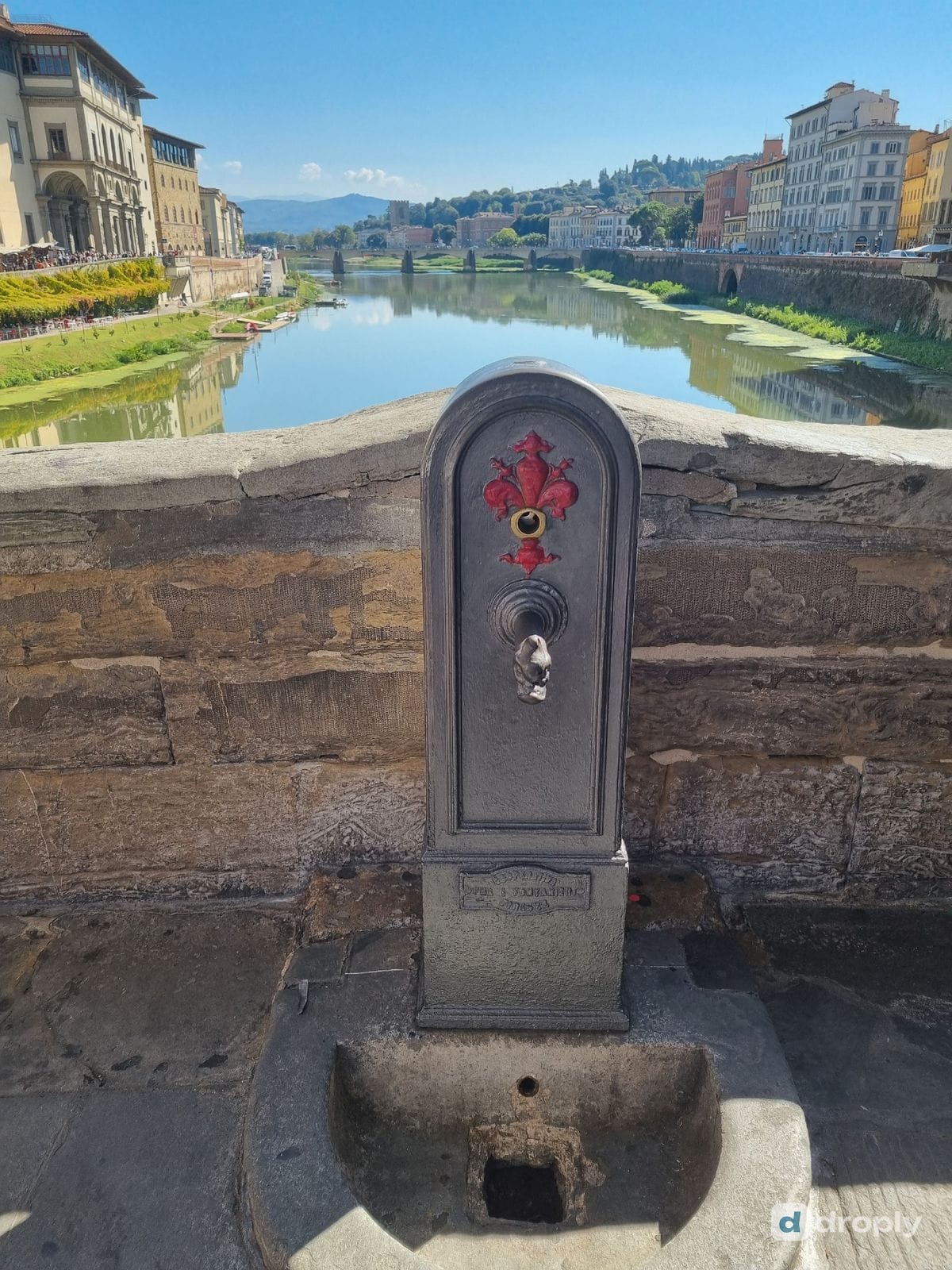
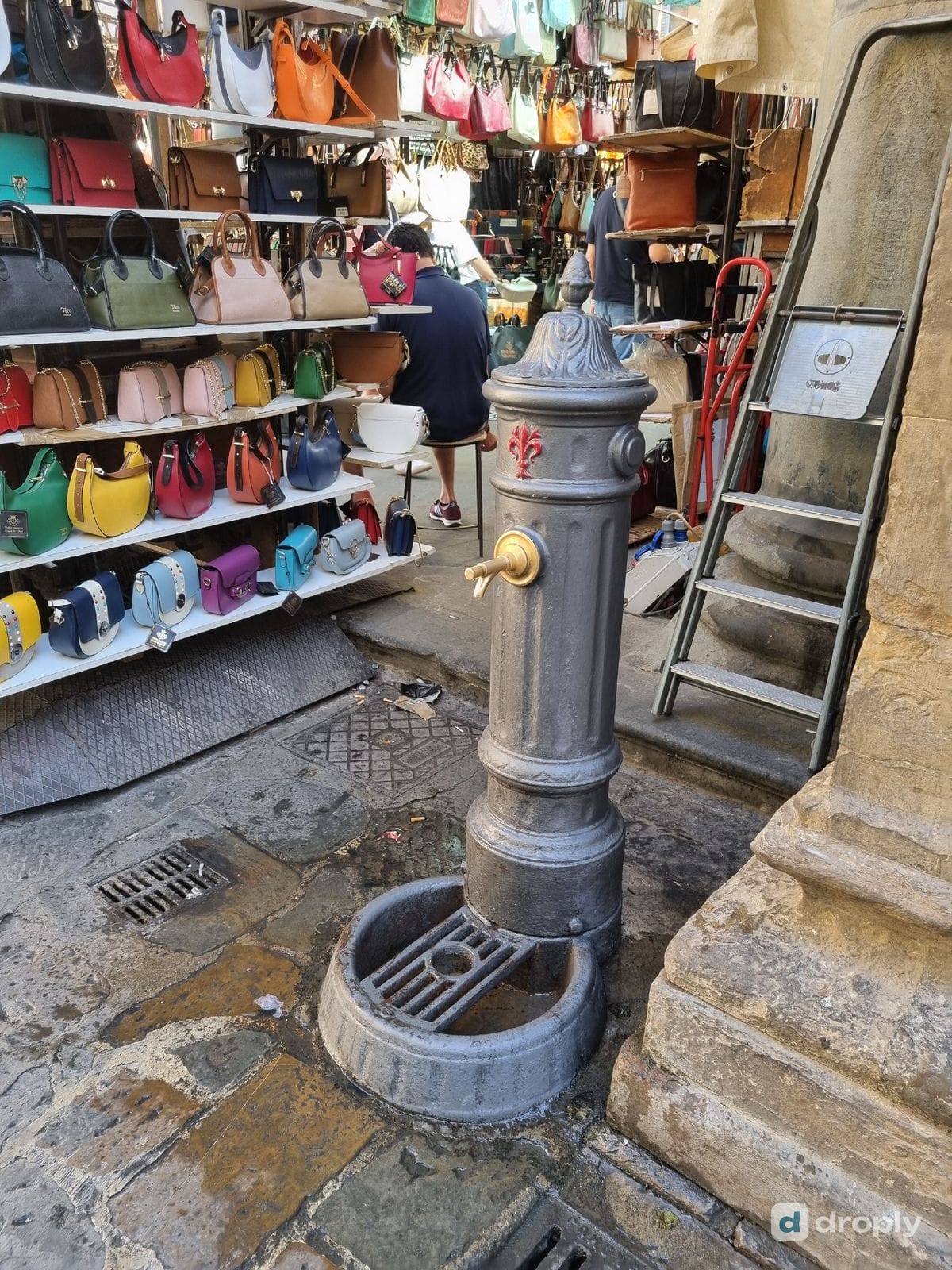
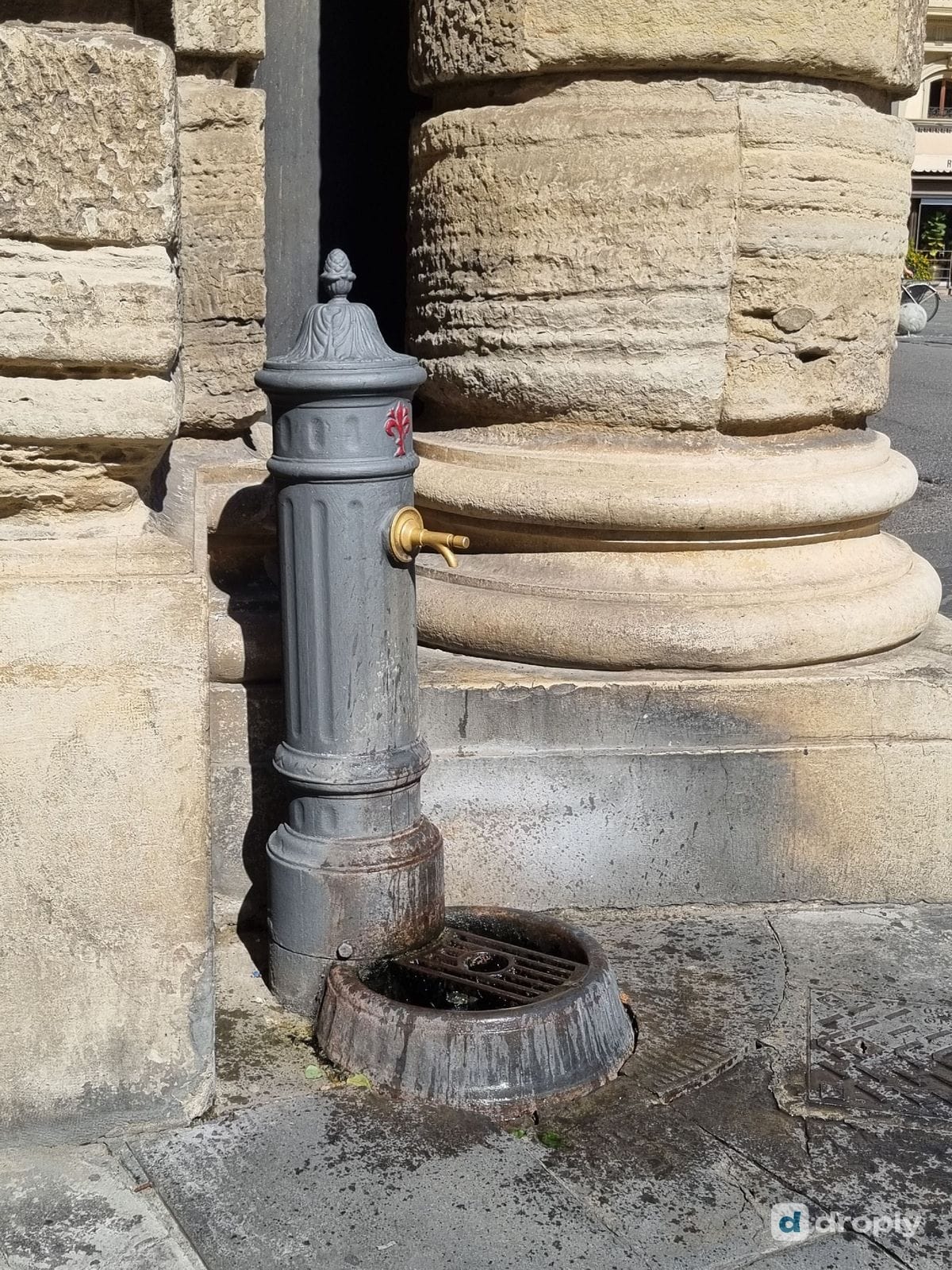
Look for a grey or dark iron post, roughly knee to waist height, with a single brass spout and a small drain or basin underneath. Most carry a small red mark near the top: the giglio, the stylized lily that’s been Florence’s civic symbol since the Middle Ages and still turns up on manhole covers, lamp posts and these taps alike.
The water runs cold, untreated beyond the normal municipal supply, and free. Some taps run continuously, others need a light press or a twist to start. None of them are decorative: if you see the giglio and a spout, it’s there to be used.
Summary: A Florence tap is a plain iron post with a brass spout, usually marked with the city’s red giglio emblem. If you see the symbol, drink.
In doubt? Head for Piazza della Signoria
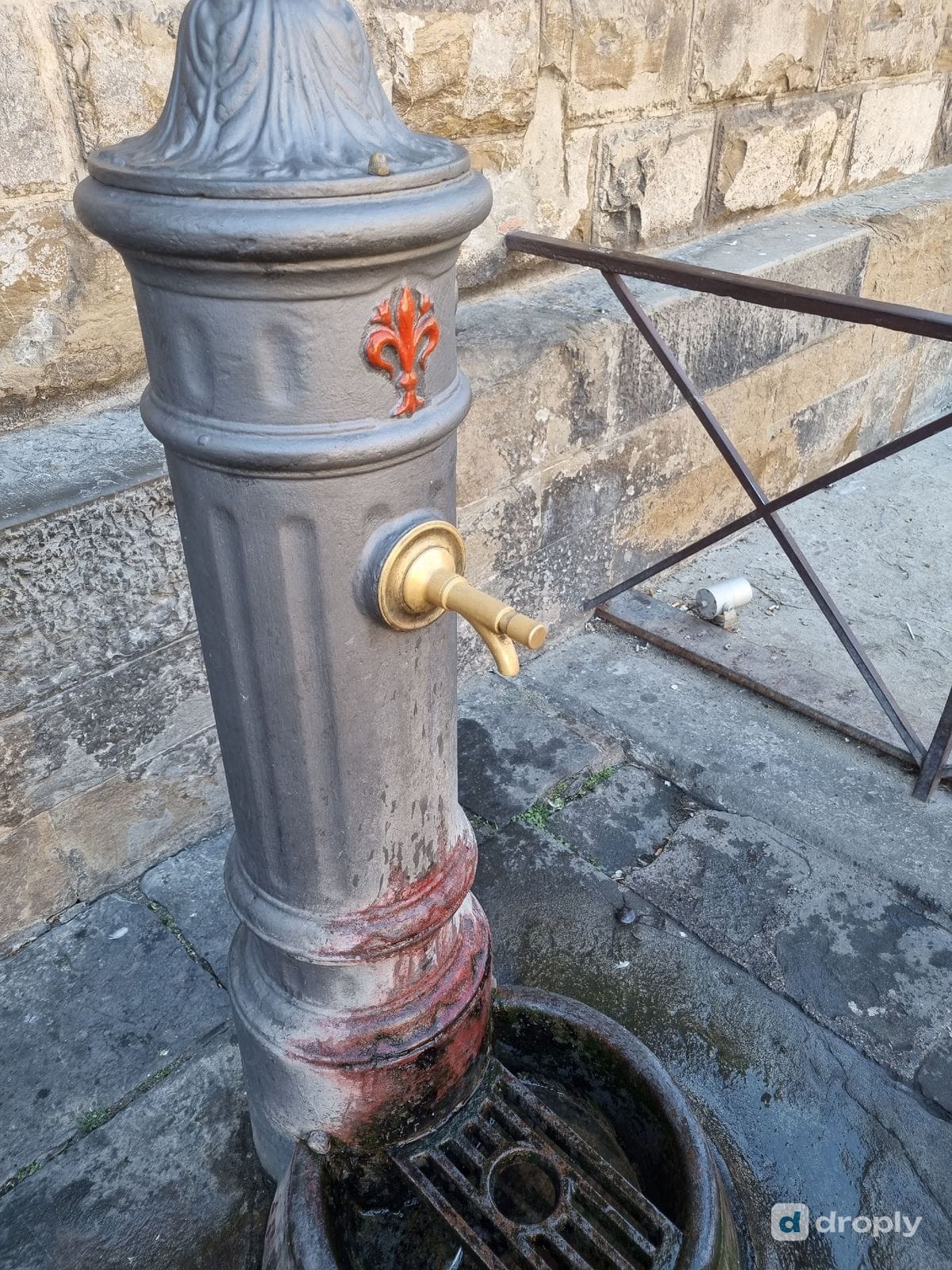
If you remember only one spot, make it this one. Piazza della Signoria is Florence’s political heart, the square in front of Palazzo Vecchio, the city’s town hall since the 14th century and still its municipal seat today. You’ll recognize it immediately by the Fontana del Nettuno, the marble and bronze fountain of Neptune and his sea horses that’s stood there since 1565.
The Neptune fountain itself isn’t a drinking fountain: it’s a monument, not a water source, so don’t fill your bottle from its basin. What you want is a few steps away, right in front of the Palazzo Vecchio entrance: a plain double-tap drinking point, two spouts side by side. One runs ordinary cold water. The other runs sparkling.
Find Neptune, find the municipality building behind him, and the real water source is standing right there in front of it, even if every other tap in the city has eluded you.
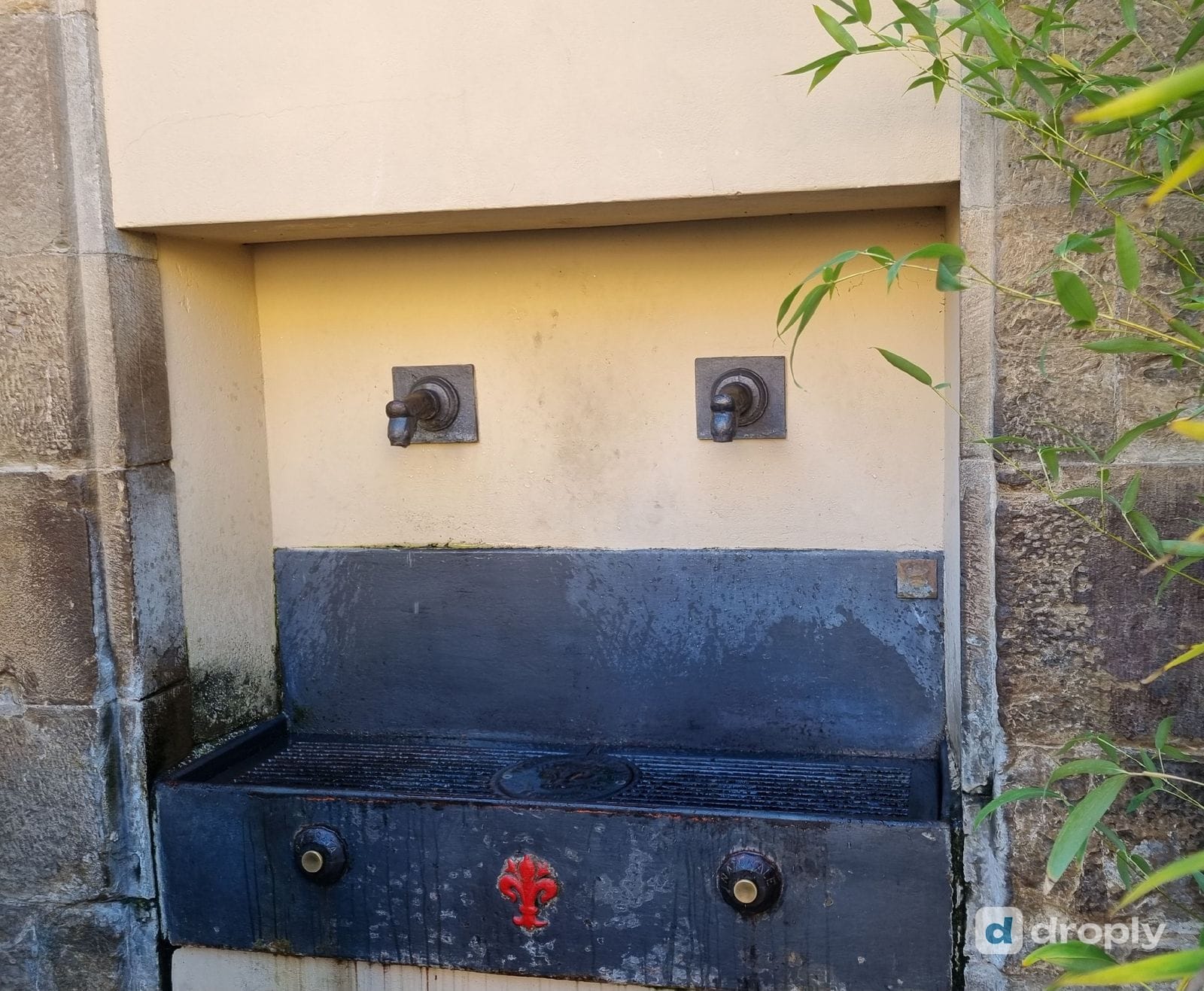
Summary: Piazza della Signoria, in front of Palazzo Vecchio, is the most reliable fallback. The Fontana del Nettuno marks the spot, but the actual drinking water is the double tap a few steps in front of the building, one side sparkling.
Can you drink from Florence’s famous fountains?
Mostly no. Florence’s best-known fountains, the Neptune in Piazza della Signoria, the fountains in the Boboli Gardens, the ones you’ll pass near Santa Croce or the Duomo, are monuments first. They were built to be looked at, not drunk from, and most carry no spout at all, just a basin.
The rule of thumb: if it has a tap or a spout, it’s meant for drinking. If it’s a basin, statue or trough with no spout, treat it as decorative and look elsewhere. That’s the opposite of Switzerland, where an unmarked fountain is presumed drinkable by default. In Florence, the drinking water is the plain iron post next to the monument, not the monument itself.
Summary: Florence’s landmark fountains are monuments, not water sources. Look for a tap with a spout, not a basin, wherever you are in the city.
Easy to miss in the crowds, and how droply helps
Even once you know what to look for, Florence’s foot traffic works against you. A tap standing quietly against a wall near the San Lorenzo market, for example, disappears behind leather stalls and the crowd moving toward them. You could walk the same street twice a day and never clock it.
That’s the gap droply fills. The map shows every tap the community has found and photographed, so you’re not relying on spotting a small iron post through a crowd of tourists and market stalls. Tap the map near wherever you’re standing, in the historic center, around the station, along the river, and see what’s actually nearby.
Summary: Florence’s taps hide in plain sight among the crowds. droply’s map shows you what’s nearby without you having to spot it yourself.
Water hiding in plain sight across the city
Some of Florence’s water points are stranger and more interesting than a plain iron post, and two of them, a few streets apart near San Lorenzo, currently tell opposite stories.
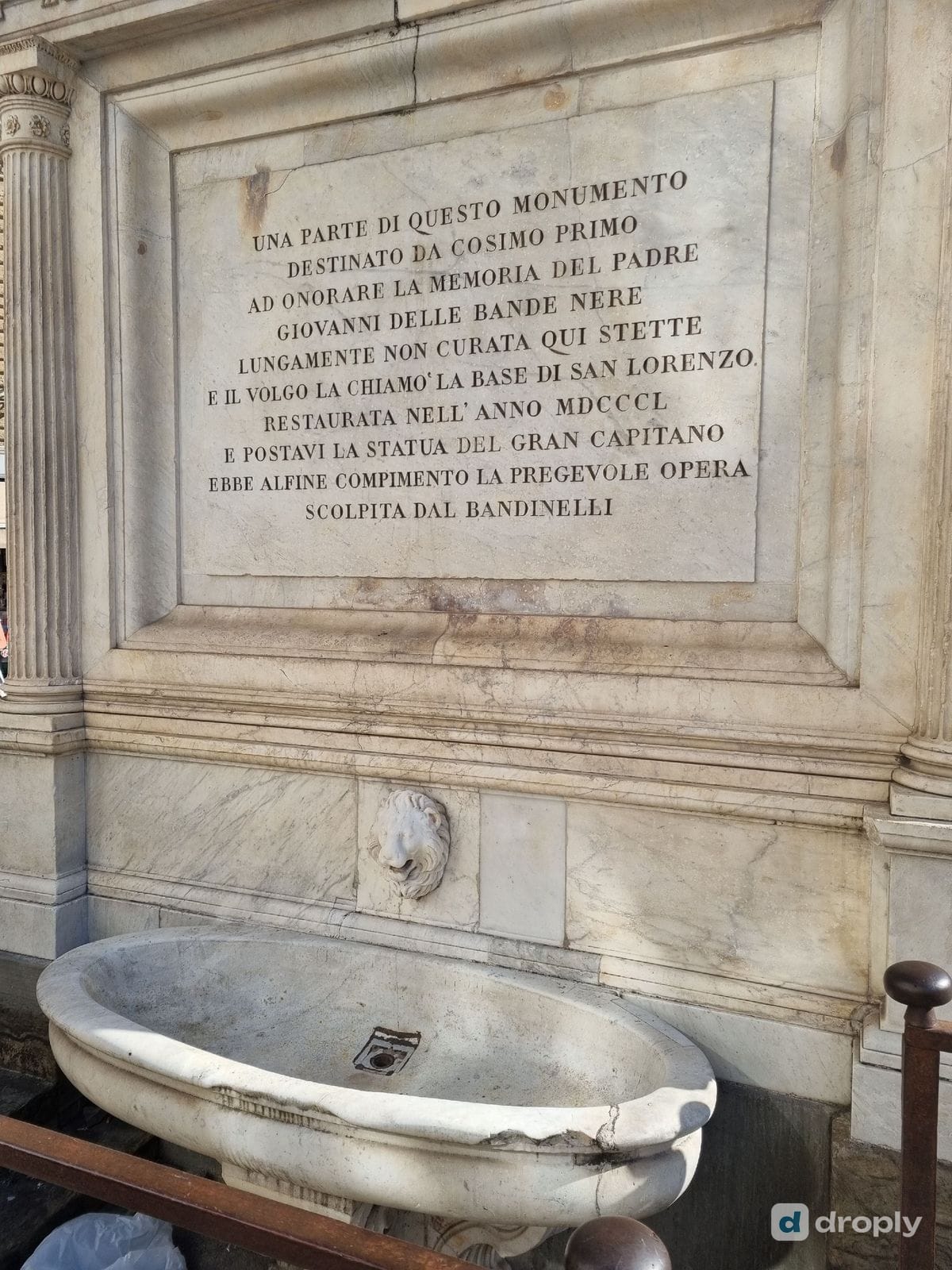
The first is a weathered stone monument dedicated to Cosimo I de’ Medici that doubles as a wall fountain, water meant to run from the same stone that carries the inscription. Right now it doesn’t: the fountain is broken and waiting on repair, another case where checking the latest status before you walk over saves you a stop for nothing.
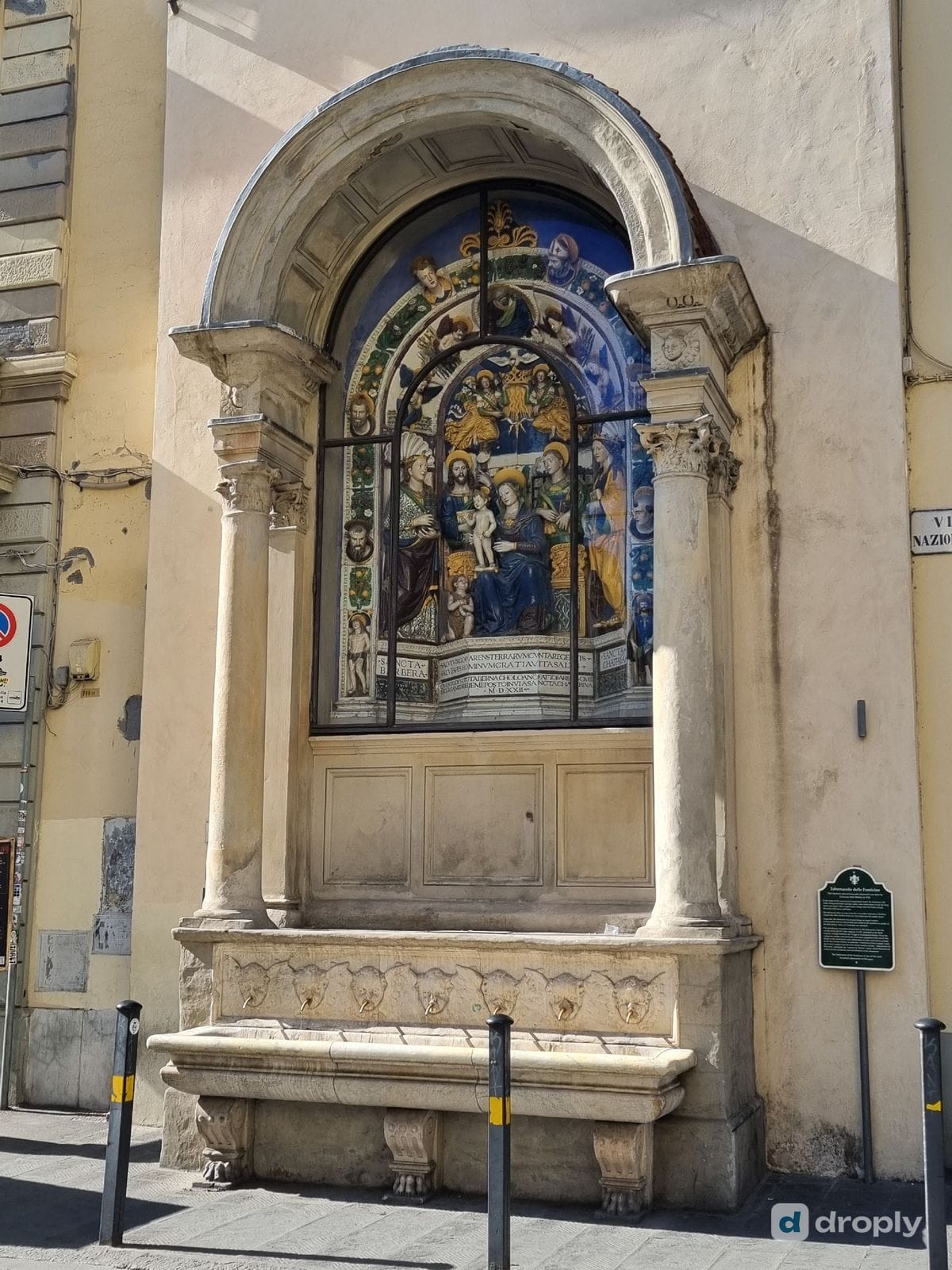
The second is the Tabernacolo delle Fonticine, and it’s worth the detour on its own merits. Girolamo della Robbia built the glazed terracotta altarpiece in 1522 for a different street entirely; it was moved to its current spot on Via Nazionale, a few steps from the San Lorenzo market, around 1850, when the city widened the road. Its nickname comes from seven small cherub heads, each pouring its own thin stream of water from a spout in its mouth into the marble basin below, which is exactly where the name Fonticine, “little fountains”, comes from. Restored in 2016, it’s fully working today: a genuine Renaissance fountain you can actually drink from, not just photograph.
Summary: Not every Florence water point looks like a fountain, and not every one of them is currently running. The Cosimo I monument near San Lorenzo is out of service right now; the Tabernacolo delle Fonticine, a working Della Robbia fountain from 1522, isn’t.
Planning a day beyond the city walls
Florence makes a good base for day trips into the Tuscan countryside, up to Fiesole’s hill views or out into the Chianti hills, and water gets noticeably harder to find the moment you leave the center. Fewer taps, longer gaps, and summer heat that makes the gaps matter.
For a planned route, load your GPX file into the droply Navigator, and the app checks it against known water sources along the way. You’ll see before you start where you can refill and where a longer dry stretch follows. For how much that actually means in liters, see our guide to how much water to carry hiking.
Summary: Water thins out fast once you leave central Florence. Load a planned route into the droply Navigator to see sources and dry stretches ahead of time.
Is tap water safe to drink in Italy?
Yes. Italian tap water is treated and monitored under the same EU drinking-water standards as the rest of the country’s food supply, and that includes the mains feeding Florence’s public taps. The city’s water utility, Publiacqua, supplies and tests it like any other household tap.
What’s not guaranteed by default, unlike Switzerland, is that every public fountain you see carries that water. Florence has no blanket rule that an unmarked fountain is drinkable: the presumption runs the other way. Look for a spout, not a basin, and when in doubt, treat a monument fountain as decorative.
One more thing worth knowing before you sit down for lunch: Italian restaurants don’t usually serve tap water for free. You’ll be offered bottled water, still or sparkling, and pay for it like any other drink. The nearest public tap is the free alternative if you’re carrying your own bottle.
Summary: Tap water in Italy, Florence included, is safe and well monitored. Not every public fountain carries it by default though, so look for a spout, and don’t expect free tap water in restaurants.
Why droply is growing in Florence
droply’s map is built by the people who use it, and that includes Florence. The city’s coverage has grown recently as more visitors and locals added their own photos of taps across the center, exactly the real, on-the-ground photos used throughout this guide. It’s not complete yet, and it won’t claim to be, but it already covers enough of the center to get you to water faster than wandering and hoping.
If you find a tap we haven’t mapped yet, add it. That’s exactly how Florence’s coverage keeps closing the gap with cities like Bern and Zurich, one photo at a time.
Frequently asked questions
Where can I find free drinking water in Florence?
At the city's public taps: plain iron posts marked with Florence's red giglio emblem, spread across the historic center and beyond. droply's map shows the ones the community has found and photographed.
Can I drink from the Fontana del Nettuno in Piazza della Signoria?
No. The Neptune fountain is a 16th-century monument, not a drinking fountain, and has no spout. The actual drinking water, including a sparkling option, is at the double tap a few steps away, right in front of Palazzo Vecchio.
Where's the easiest spot to remember for water in Florence?
Piazza della Signoria. Find the Fontana del Nettuno, then look for the double-tap drinking fountain in front of Palazzo Vecchio, the city's town hall, a few steps away. One of the two taps pours sparkling water.
How do I recognize a Florence drinking tap?
Look for a grey or dark iron post with a single brass spout over a small drain, usually marked with a small red fleur-de-lis, the giglio, Florence's civic symbol. If it has a spout and the mark, it's for drinking.
Is tap water safe to drink in Florence and the rest of Italy?
Yes. Italian tap water meets the same EU drinking-water standards as the rest of the country's food supply. Florence's water utility, Publiacqua, supplies and monitors it.
Can I assume every public fountain in Florence is drinking water?
No. Unlike Switzerland, Florence has no default rule that an unmarked fountain is drinkable. Many of the city's best-known fountains are monuments with no spout at all. Look for a tap with a spout; treat a basin or statue fountain as decorative.
Why are Florence's drinking taps so easy to miss?
They're small, low to the ground, and built into walls, columns or even historic monuments, with nothing about them as eye-catching as the sights around them. Add Florence's crowds around the Duomo, Uffizi and Ponte Vecchio, and a tap can hide in plain sight for years.
Do Florence's historic monuments ever double as fountains?
Occasionally, yes. A stone monument near San Lorenzo dedicated to Cosimo I de' Medici has a fountain built into its base, though it's currently out of service. A few streets away, the Tabernacolo delle Fonticine, a glazed terracotta altarpiece by Girolamo della Robbia from 1522, is fully working: seven small cherub-head spouts still pour water into its basin.
What is the Tabernacolo delle Fonticine?
A glazed terracotta altarpiece near the San Lorenzo market, made by Girolamo della Robbia in 1522 and moved to its current spot on Via Nazionale around 1850, when the city widened the road. Its name means little fountains: seven cherub heads pour water from spouts into a marble basin below. Restored in 2016, it's fully working today, a Renaissance fountain you can actually drink from.
How do I know if a Florence tap is actually running before I walk there?
Check droply. Status changes, sometimes for maintenance, sometimes because something breaks and waits on a city repair, and a photo from last month doesn't tell you what's true today. droply shows the latest status reported by the community, and if you find a tap that's different from what's shown, reporting it helps the next person.
Do restaurants in Florence serve free tap water?
Usually not. Like much of Italy, restaurants typically serve and charge for bottled water, still or sparkling, rather than offering tap water by default. The nearest public tap is the free alternative if you're carrying a bottle.
How do I find water on a day trip outside Florence, for example to Fiesole or Chianti?
Load your planned route as a GPX file into the droply Navigator, and the app shows known water sources and the dry stretches between them along the track. Water thins out fast once you leave the historic center, so it's worth checking before you set out.
How does droply help in a city where fountains are hard to spot?
By showing you what's already been found. Every tap the community has photographed and mapped in Florence appears on the droply map, so you're not relying on spotting a small iron post yourself in a crowd of tourists.
Is Florence's drinking-water coverage on droply complete?
Not yet. Coverage grows as users in Florence add their own photos and reports, and it's grown recently. It's enough to get you to real, working taps across the center, but if you find one that isn't mapped, add it.
Published on
← Back to blog  By Micha · Co-Founder, droply
CDT thru-hiker (2024) · Co-founder of droply
Micha co-founded droply after thru-hiking the Continental Divide Trail in 2024. A former scout and lifelong outdoor enthusiast, he's always chasing water sources to map: hidden natural springs and hot springs are his favorites.
Get new posts in your reader
New guides and trail notes land in your feed reader the day they're published. No email address, no account, no tracking.
Feed address
https://droply-app.com/rss.xml