


· Micha
Mountain Water: Why Every Spring Tastes Different
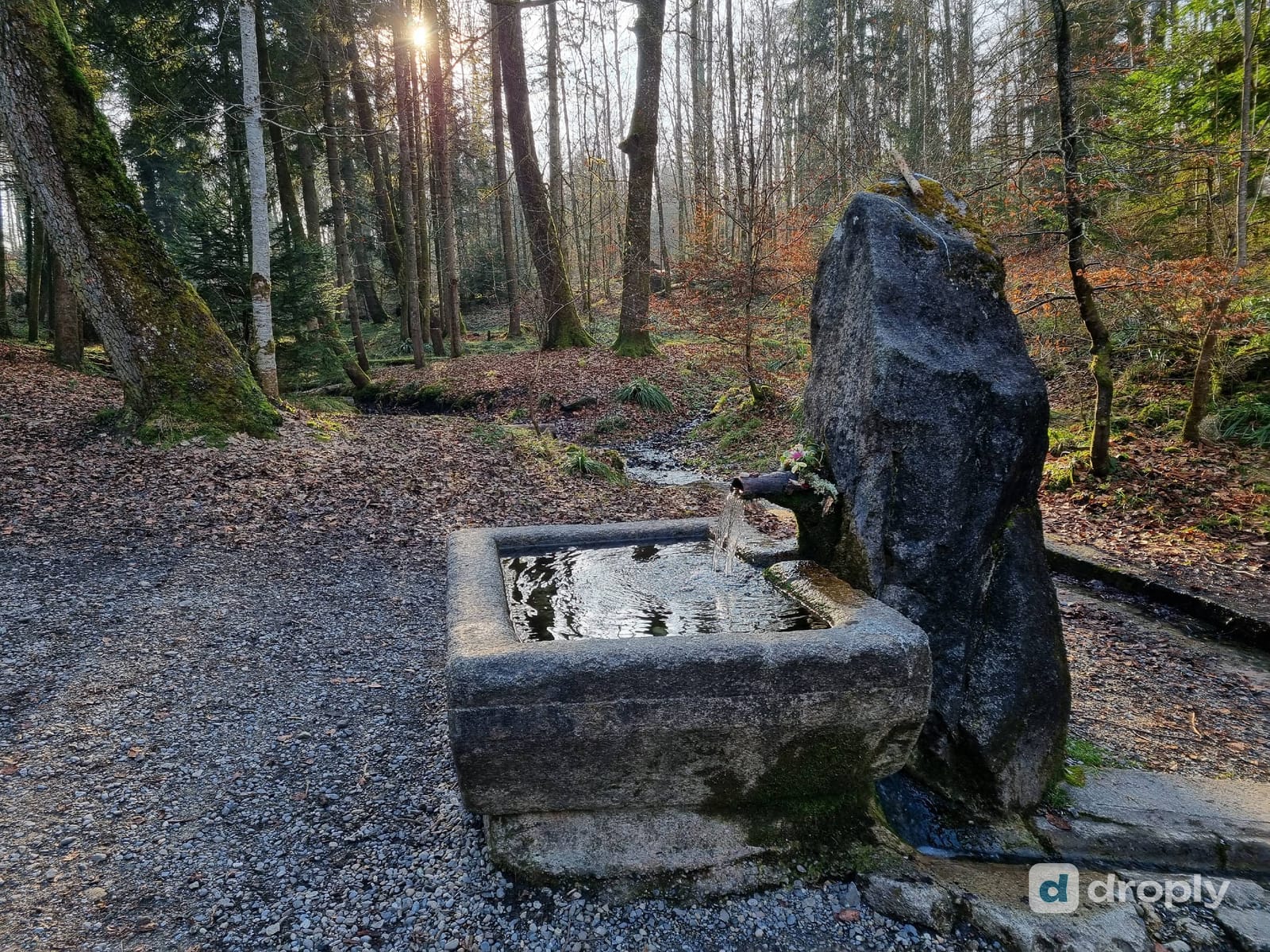
Two springs on the same mountain, a few hundred meters apart, taste completely different. What water dissolves out of the rock on its way down, why altitude has nothing to do with it, and when you shouldn't drink.
Water tastes like the minerals it dissolved out of the rock on its way to you. Pure H₂O basically doesn’t exist in nature. Rain falls almost mineral-free, and from the moment it soaks into the ground it picks up whatever the subsurface gives it.
That’s why one spring can taste mild and soft while the next one on the same slope tastes slightly bitter or dry. It’s also why “mountain water” describes a location, not a flavor.
For planning on the trail this matters in a concrete way: a spring is not just a spring. That’s why droply assigns every point on the map a water type, spring water, natural spring, drinking fountain, tap water, ground water, mineral water, creek, water pond or hot spring, instead of dropping the same generic water pin everywhere. The type tells you more about what’s waiting for you than any elevation figure.
Why does water taste like anything at all?
Because you’re not tasting the liquid, you’re tasting the ions dissolved in it. The total amount of them is called mineralization, or TDS (total dissolved solids). It ranges from under 20 milligrams per liter in fresh snowmelt to over 2000 milligrams per liter in heavily mineralized water. That’s a factor of more than a hundred between two things that both look clear and are both called water.
Which ion dominates decides the direction of the taste:
| Dissolved substance | Usually comes from | Taste impression |
|---|---|---|
| Calcium (Ca²⁺) | Limestone, gypsum | neutral to “full”, slightly chalky in quantity |
| Magnesium (Mg²⁺) | Dolomite | slightly bitter |
| Bicarbonate (HCO₃⁻) | Dissolution of limestone | soft, mild, rounds the taste off |
| Sulfate (SO₄²⁻) | Gypsum, anhydrite | dry, astringent finish |
| Sodium (Na⁺) | Salt-bearing rock, coastal areas | slightly salty |
| Chloride (Cl⁻) | Salt-bearing rock, road salt, wastewater | salty |
| Silica (SiO₂) | Granite, basalt, volcanic rock | no noticeable taste |
On top of that come trace elements like iron, manganese, zinc, lithium or strontium. Most sit so far below the perception threshold that they contribute nothing to taste. Iron is the exception: it turns metallic in small amounts already.
So the taste difference between two springs is neither coincidence nor imagination. It’s a measurable composition.
How do the minerals get into the water in the first place?
Through weathering. Rainwater picks up carbon dioxide as it falls and in the soil, which makes it slightly acidic, and it dissolves rock on its way through the subsurface. Limestone reacts to that particularly readily: it releases calcium and bicarbonate, exactly the two ions that make water taste soft and mild. Gypsum releases calcium and sulfate. Dolomite adds magnesium. Granite, gneiss and basalt weather far more slowly and mainly release silica and not much else.
How much of it ends up in the water depends on three things: which rock lies along the path, how long the water is in contact with it, and how fast it flows. Water that shoots through a fractured system in a few days dissolves almost nothing. Water that sits in an aquifer for decades comes out heavily mineralized. That’s why many of the heavily mineralized bottled waters are old, decades to centuries, in some cases far more.
The U.S. Geological Survey puts the result on a scale that’s useful for orientation. Under 60 mg/L counts as soft, 61 to 120 mg/L as moderately hard, 121 to 180 mg/L as hard, and above that as very hard.
In short: the spring doesn’t make the water. The path to it does.
Is mountain water automatically mineral-rich?
No, and this is the most persistent misconception on the topic. Mineralization depends on rock type, residence time and flow speed. Elevation appears in none of those three.
How far apart the results can be is easiest to see in three French waters. All three come from protected underground sources, and all three could hardly be more different:
| Source rock | Calcium | Magnesium | Sulfate | |
|---|---|---|---|---|
| Volvic | Volcanic rock, Chaîne des Puys | 12 mg/L | 8 mg/L | very little |
| Evian | Alpine glacial deposits | 78 mg/L | 24 mg/L | 10 mg/L |
| Hépar | Gypsum and marl layers, Vosges | 549 mg/L | 119 mg/L | 1530 mg/L |
The figures for Evian and Hépar come from the IRBMS overview of mineral content in drinking water. Volvic runs through young volcanic rock and carries a lot of silica accordingly (32 mg/L), but almost no hardness minerals. Its total mineralization is 109 mg/L.
Between Volvic and Hépar there’s a factor of 45 in calcium. Both come from protected sources, both from mountain regions, both are clear. The difference is geology and nothing else.
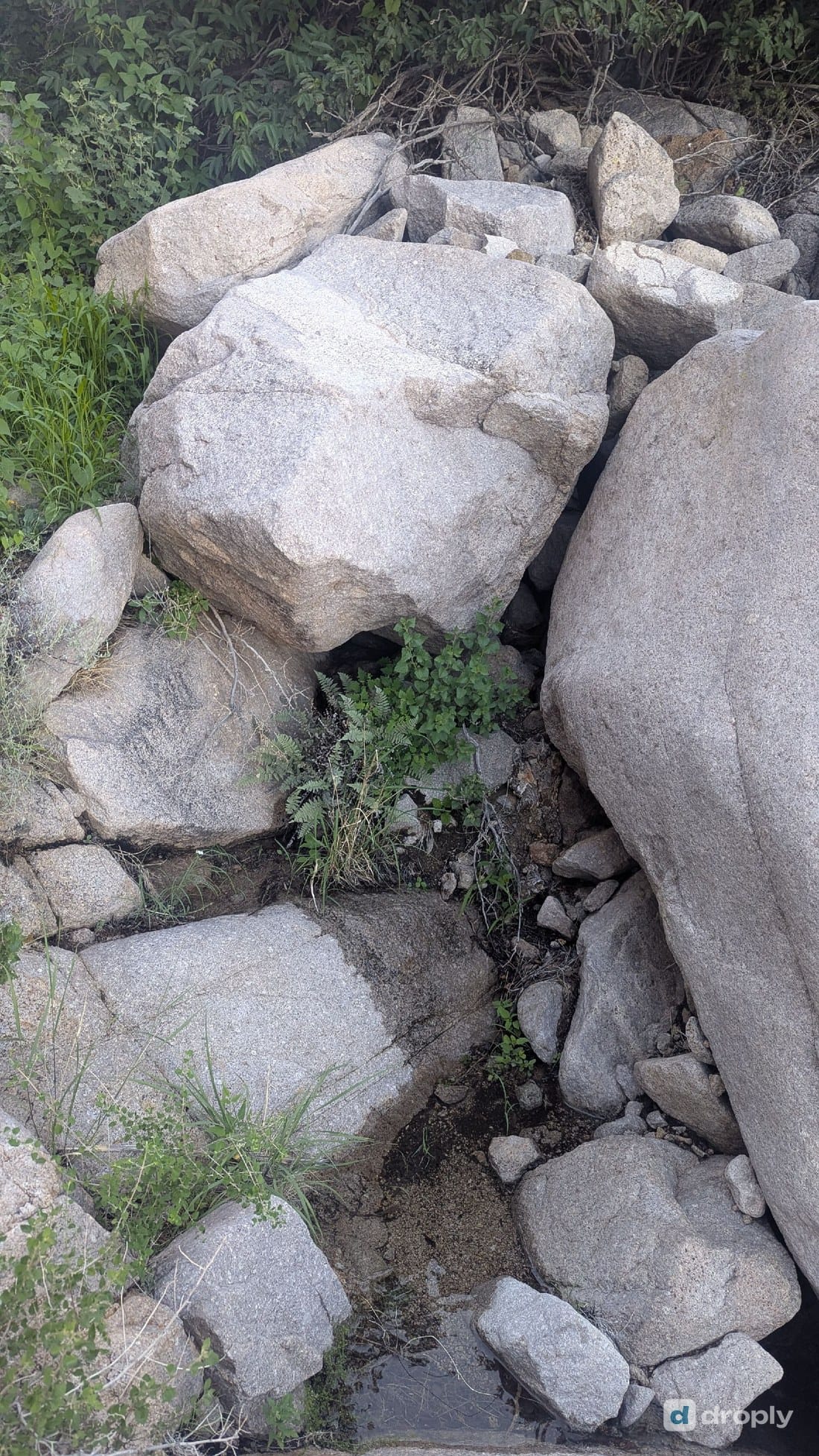
In the Alps these contrasts sit right next to each other. The Northern Limestone Alps, the Dolomites and large parts of the pre-Alps are limestone and dolomite. The Central Alps, Aar massif, Gotthard, Mont Blanc area, are granite and gneiss. A spring fed by a limestone layer can carry hundreds of milligrams of calcium per liter. A spring a few hundred meters away, fed by fracture water in crystalline rock, is barely mineralized at all. Both sit at 2000 meters. Both look the same.
The practical conclusion: if some water tasted unusually good to you somewhere, the odds are low that the spring in the next valley tastes the same.
Is mineral-rich water healthier than tap water?
Sometimes, but not as a rule, and considerably less than the labels suggest. In its review of calcium and magnesium in drinking water, the WHO states that food is the principal source of both minerals. Dairy alone covers more than half of calcium intake in many diets, while magnesium arrives spread across vegetables, grains, fruit and nuts. Water is an addition, not a base.
The addition can still be relevant. Against a reference value of around 1000 milligrams of calcium per day for adults, a liter of Hépar at 549 mg delivers more than half of it. A liter of Volvic delivers 12 mg, which is effectively nothing. If you sweat a lot, eat few dairy products or drink several liters a day, the choice of water stops being purely a taste question.
Two limits belong with that. First, it only counts for water you actually drink in that quantity. A heavily mineralized water you have two glasses of per day changes nothing in the balance. Second, very high sulfate has a noticeable side effect: the 1530 mg/L of sulfate in Hépar is laxative in larger amounts. That brand actually advertises this, and it’s the exact opposite of what you want on trail.
If you’re curious where your own tap water sits on this scale, it’s cheap to find out. A handheld TDS meter reads total dissolved solids in ppm in a couple of seconds. It won’t tell you which minerals are in there, that needs a lab or your utility’s annual water report, but it puts a number on soft versus hard versus heavily mineralized. It’s genuinely interesting to carry through a few different taps and springs.
Spring water or mineral water: where is the difference?
The difference is legal, not a matter of taste. The EU protects the term natural mineral water under Directive 2009/54/EC. It has to originate in an underground water table or deposit and emerge from a tapped spring. It must be microbiologically wholesome at source, come from a source demonstrably protected from pollution, remain stable in composition and temperature, and be officially recognized. Chemical treatments that change the composition are excluded. What’s allowed is essentially physical steps like removing iron or sulfur and handling the carbon dioxide.
Spring water also comes from a protected underground source and is also bottled on site, but it doesn’t have to hold a constant mineral content and doesn’t need official recognition of its composition. Instead it meets the requirements for drinking water.
So what separates the two terms is consistency and official recognition, not the amount of minerals. A mineral water can be less mineralized than the tap water you make coffee with at home. And an untapped mountain spring you drink from on trail falls under neither definition: legally it’s simply surface or spring water with no assurances attached.
Can you change what is in your tap water at home?
Yes, but each method changes something different, and most of them don’t do what people assume. Start by knowing what you actually have. Your utility publishes an annual water quality report, and a TDS reading tells you where you sit on the hardness scale. Buying treatment before measuring is how people end up removing something that was never there.
- Activated carbon (pitcher, faucet or under-sink) binds chlorine, odor compounds and many organic contaminants. It changes the taste noticeably and leaves calcium and magnesium in the water. Granular activated carbon is also one of the treatment technologies the EPA identifies as effective for PFAS.
- Ceramic gravity systems work without plumbing or power. The British Berkefeld gravity system with Ultra Sterasyl candles from Doulton combines a ceramic microfilter shell with granular activated carbon and heavy-metal removal media. It reduces bacteria, trace organics and metals like lead, and leaves the dissolved minerals where they are. It is not a softener and does not claim to be one.
- Reverse osmosis is the only common method that actually removes the minerals. It pushes water through a membrane tight enough to strip essentially all dissolved solids. That’s why RO water tastes flat, and why systems like the RKIN Zero Installation Purifier run an AlcaPure post-filter that puts calcium and magnesium back afterwards. It’s certified to NSF/ANSI 58 for reduction of TDS, fluoride, lead, PFOA and PFOS.
- Water softeners are the method most often misunderstood. A softener does not purify anything: it exchanges calcium and magnesium for sodium. Scale goes away, the water tastes different and slightly saltier, and the contaminant profile is unchanged.
The PFAS question at home has a moving legal answer worth knowing. The EPA’s 2024 rule set enforceable limits of 4 parts per trillion for PFOA and PFOS. In May 2026 the agency proposed to keep those two limits while extending the compliance deadline to 2031, and rescinding the standards for four further PFAS compounds. In other words, utility-side treatment is coming, but slowly, the honest reason some households treat at the tap in the meantime.
The rule of thumb: measure first, then pick the method that targets what you actually found.
Is snowmelt good drinking water?
As a short-term solution yes, as a permanent water source only with limits, for three independent reasons.
It supplies almost no electrolytes. Freshly melted snow never had meaningful contact with rock and sits close to rainwater in mineralization. Over a day that doesn’t matter. If you drink nothing but snowmelt for several days while sweating, you replace fluid but hardly any salts. At that point electrolytes belong in the plan.
Snow collects whatever is in the air. A snowpack acts as a filter for the atmosphere across an entire winter. Particulates, soot, nitrogen compounds and heavy metals settle in with every snowfall and stay there until it melts. Fresh snow is not the same thing as clean snow.
Snow is not microbiologically sterile. Animal droppings, bacteria and microorganisms show up in old snowfields too, especially in grazed terrain. The same rule as for any surface source applies: boil or filter.
Snowmelt is good for getting across a dry stretch, and poor as a default supply.
How clean is glacier water really?
Cleaner than most surface water, but not untouched. The idea that “glacier equals purest water” doesn’t survive contact with the measurements. Glaciers are archives built up over decades. Whatever was deposited from the atmosphere with snow and rain in that time sits in the ice, and is released again as it melts.
The best-documented case is PFAS, the per- and polyfluoroalkyl substances nicknamed “forever chemicals” for their persistence. They are water-soluble, distributed widely through the atmosphere, and turn up far from any industry as a result. A study on Mount Everest detected PFAS in glacial meltwater, about as remote as measurement gets. For the Alps, a non-target analysis of snow and surface waters shows that both legacy and emerging contaminants are detectable across the range.
Switzerland gives the clearest sense of scale. The Swiss Federal Office for the Environment’s NAQUA groundwater monitoring campaign found PFAS at just under half of all monitoring sites nationwide, and at over 90 percent of sites in settled areas. It found PFAS markedly less often in the pre-Alps and Alps, with current limits exceeded at only a single site. That’s the realistic framing: the Alps are not the problem area, but they’re not outside it either.
In practice this calls for a corrected expectation rather than alarm. A glacier stream is not a purity guarantee, and where a tapped spring or a monitored tap exists it’s the better choice for other reasons anyway, filtered mountain water is not automatically safe either.
What does a filter remove, and what doesn’t it?
A backpacking filter removes pathogens but not minerals, which is the decisive point where taste is concerned. A hollow-fiber filter rated 0.1 to 0.2 microns works by size. Bacteria and protozoa are held back, and dissolved ions are roughly a thousand times smaller and pass through unchanged. Filtered spring water tastes exactly like unfiltered spring water. The filter changes the microbiology, not the chemistry.
The other methods each act somewhere else:
- Activated carbon binds organic compounds, chlorine and odor. It changes the taste noticeably but leaves most of the calcium and magnesium in the water.
- Chemical treatment (chlorine dioxide, silver ions) deactivates organisms and does nothing mineral at all, beyond tasting of something itself.
- Reverse osmosis is the one method that genuinely strips the minerals out, which is why it belongs at home and not in a pack.
For PFAS the distinction matters most. A hollow-fiber filter does nothing against them, because PFAS are dissolved and cannot be screened out by size. If that matters to you for a specific region, you need a carbon stage. The Water to Go Active bottle, for instance, combines a mechanical stage, an electrostatically charged layer and activated carbon in a single filter, and states a PFAS reduction. That’s a manufacturer claim, but one that at least names the right mechanism. For bacteria and protozoa your normal filter remains entirely sufficient.
So if your water suddenly tastes different from usual, that’s the source, not the filter.
How do you tell which kind of source you are dealing with?
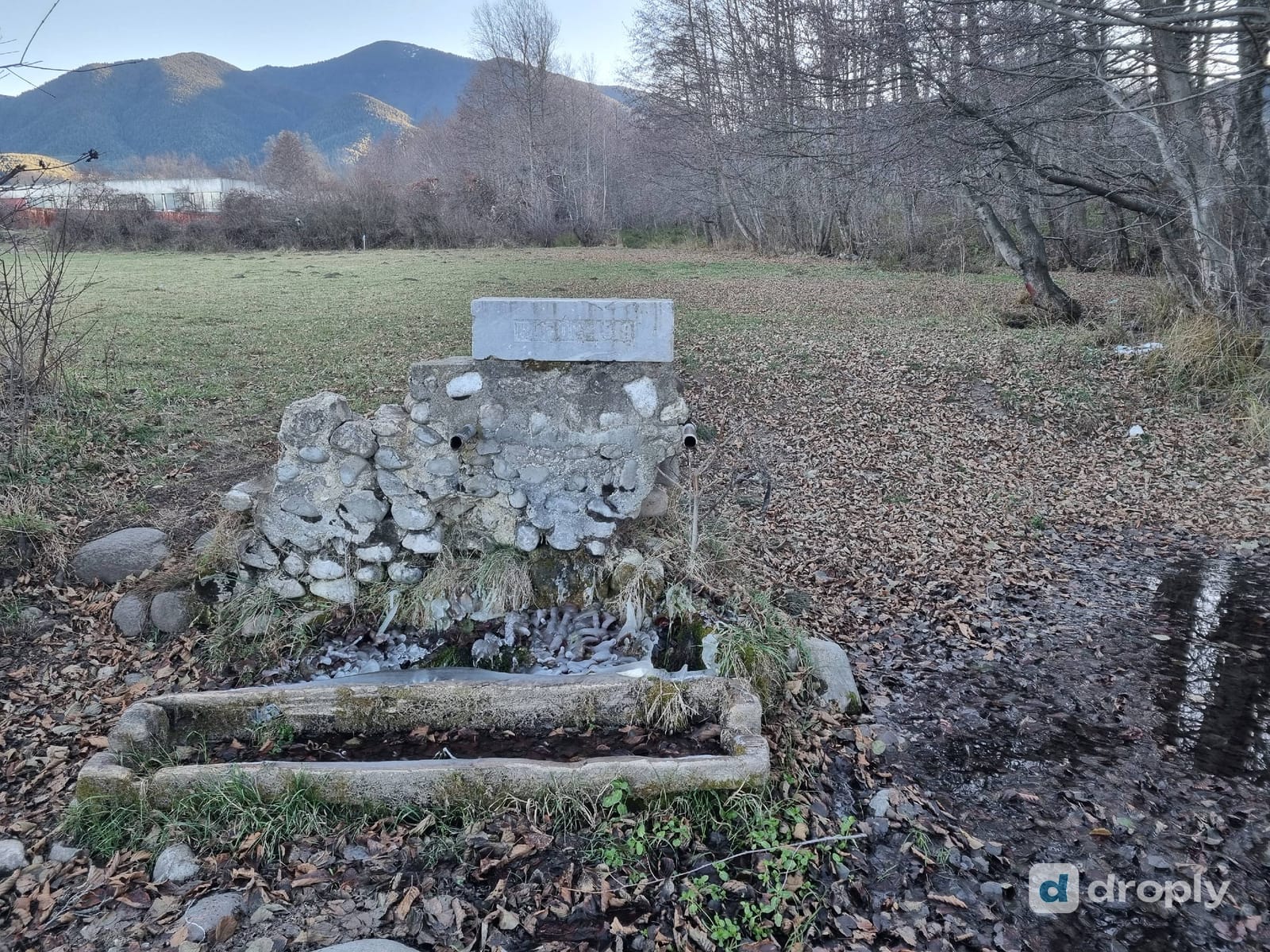
By checking what type of water point lies ahead before you set out. The type tells you more about mineralization and safety than any look at the water does. A tapped drinking fountain in a village is usually connected to a treated, monitored supply. A natural spring on a slope carries the chemistry of its catchment and the uncertainty of the pasture above it. A creek is surface water with everything that implies. All three look identical on a generic map.
The Glasbrunnen in the Bremgartenwald near Bern, the cover photo of this article, is exactly that kind of case. It’s a tapped forest spring running from a wooden spout into a stone trough, easy to reach and well visited. It is still a spring and not a village fountain on a monitored supply, and that difference is precisely what you want to know beforehand.
That distinction is built into droply. Every point carries a water type, spring water, natural spring, drinking fountain, tap water, ground water, mineral water, creek, water pond, hot spring, instead of a generic marker.
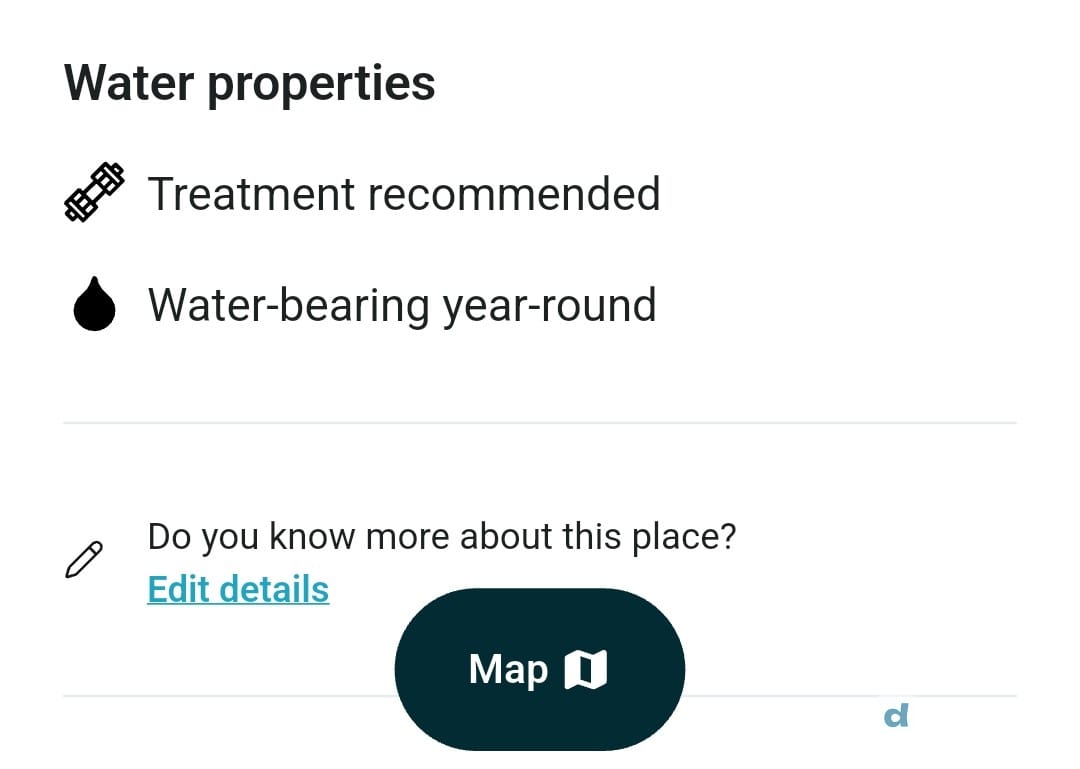
On top of that come source-specific properties. A spring can be marked as water-bearing year-round, or as one where treatment is recommended despite being mapped. That’s the honest version: not every mapped source is drinkable untreated, and the app does not pretend otherwise.
And finally, recency counts. Whether a spring is still running in August is not something a geological map knows. Only somebody who was there last week does. That’s what the community check-ins are for.
So the next time you stand at a spring that tastes different than you expected: you did nothing wrong. You’re just a few rock layers further along.
Key takeaways
The taste of a spring is its composition, and its composition is geology. Limestone and dolomite make mineral-rich water, granite and basalt make mineral-poor water, and residence time underground decides the rest. Altitude is irrelevant to all of it. Minerals in water are a sensible addition to diet but not a replacement for it. And snowmelt and glacier water are low in minerals and considerably less untouched than they look. That’s no cause for worry, but it’s a reason to prefer a known tapped source when one is within reach.
Find out what is ahead of you before you drink:
- Use droply to find springs, fountains, taps and refuges along your route.
- See from the water type whether a tapped drinking point or a natural spring is waiting for you.
- Check a source’s properties, such as whether treatment is recommended, before you walk to it.
- Rely on recent community check-ins instead of a five-year-old pin.
- Carry less water with more confidence, because you know what is actually coming.
Frequently asked questions
Why does every spring taste different?
Because water dissolves minerals out of the rock it passes through, and every rock gives up something different. Calcium and bicarbonate from limestone taste soft and mild, sulfate from gypsum tastes dry and bitter, magnesium is slightly bitter, sodium slightly salty. Two springs on the same mountain can taste completely different if their water ran through different layers.
Is mountain water more mineral-rich than tap water?
Not automatically. What matters is rock type, residence time underground and flow speed, not altitude. Water from limestone and dolomite areas is often mineral-rich, while water from granite and gneiss regions is usually very mineral-poor, sometimes more so than the tap water down in the valley.
Does a water filter remove the minerals from water?
A normal backpacking filter does not. Hollow-fiber filters rated 0.1 to 0.2 microns hold back bacteria and protozoa. Dissolved minerals are roughly a thousand times smaller and pass straight through. Only reverse osmosis actually removes them, which is why RO water tastes flat, and why many systems add calcium and magnesium back afterwards.
Can you drink glacier and snowmelt water safely?
Not by default. Snowmelt is very low in minerals and supplies almost no electrolytes. It holds a whole winter’s worth of atmospheric deposition, and it’s not microbiologically clean just because it’s frozen. Melting glaciers also re-release pollutants such as PFAS that were locked in the ice for decades.
What is the difference between spring water and mineral water?
The difference is legal, not a matter of taste. In the EU, natural mineral water is protected under Directive 2009/54/EC: protected underground origin, microbiologically wholesome at source, stable composition, and official recognition. Spring water also comes from a protected underground source but doesn’t have to hold a constant mineral content.
How do you change the mineral content of tap water at home?
Carbon and ceramic filters improve taste and remove contaminants while leaving calcium and magnesium in the water. Reverse osmosis removes essentially all dissolved solids, including the minerals, which is why many RO systems add them back with a remineralizing post-filter. A water softener does not purify anything, it swaps calcium and magnesium for sodium.
Frequently asked questions
Why does every spring taste different?
Because water dissolves minerals out of the rock it passes through, and every rock gives up something different. Calcium and bicarbonate from limestone taste soft and mild, sulfate from gypsum tastes dry and bitter, magnesium is slightly bitter, sodium slightly salty. Two springs on the same mountain can taste completely different if their water ran through different layers.
Is mountain water more mineral-rich than tap water?
Not automatically. What matters is rock type, residence time underground and flow speed, not altitude. Water from limestone and dolomite areas is often mineral-rich, while water from granite and gneiss regions is usually very mineral-poor, sometimes more so than the tap water down in the valley.
Does a water filter remove the minerals from water?
A normal backpacking filter does not. Hollow-fiber filters rated 0.1 to 0.2 microns hold back bacteria and protozoa. Dissolved minerals are roughly a thousand times smaller and pass straight through. Only reverse osmosis actually removes them, which is why RO water tastes flat, and why many systems add calcium and magnesium back afterwards.
Can you drink glacier and snowmelt water safely?
Not by default. Snowmelt is very low in minerals and supplies almost no electrolytes. It holds a whole winter's worth of atmospheric deposition, and it's not microbiologically clean just because it's frozen. Melting glaciers also re-release pollutants such as PFAS that were locked in the ice for decades.
What is the difference between spring water and mineral water?
The difference is legal, not a matter of taste. In the EU, natural mineral water is protected under Directive 2009/54/EC: protected underground origin, microbiologically wholesome at source, stable composition, and official recognition. Spring water also comes from a protected underground source but doesn't have to hold a constant mineral content.
How do you change the mineral content of tap water at home?
Carbon and ceramic filters improve taste and remove contaminants while leaving calcium and magnesium in the water. Reverse osmosis removes essentially all dissolved solids, including the minerals, which is why many RO systems add them back with a remineralizing post-filter. A water softener does not purify anything, it swaps calcium and magnesium for sodium.
Published on
Some links in this article are affiliate links. If you buy through them, we may earn a commission at no extra cost to you. It never affects our recommendations.
← Back to blog  By Micha · Co-Founder, droply
CDT thru-hiker (2024) · Co-founder of droply
Micha co-founded droply after thru-hiking the Continental Divide Trail in 2024. A former scout and lifelong outdoor enthusiast, he's always chasing water sources to map: hidden natural springs and hot springs are his favorites.
Get new posts in your reader
New guides and trail notes land in your feed reader the day they're published. No email address, no account, no tracking.
Feed address
https://droply-app.com/rss.xml