


· Micha
Drinking Water in Bern: The Fountain Capital and Its History
droply lists about 250 drinking-water fountains in the Bern area, around 50 of them in the UNESCO Old Town. A guide to where you can refill for free, the stories behind the famous figure fountains, and why the Glasbrunnen in the forest is still worth the trip.
Bern is known as the fountain city of Switzerland. We built droply as a team of two in Switzerland. This article has both: where you reliably find water in Bern, and the history behind the fountains you pass on the way.
Where do you find drinking water in Bern?
At the nearest public fountain, and in the Old Town that is never far. Between the train station and the Nydegg bridge, the fountains along Spitalgasse, Marktgasse, Kramgasse and Gerechtigkeitsgasse follow each other almost every minute. The Old Town has been a UNESCO World Heritage Site since 1983.
Not all fountains belong to the city. Energie Wasser Bern maintains the city’s fountains, the others belong to other owners, for example the Burgergemeinde or private parties. On the road this rarely matters, for the question “is it running, and is it drinking water?” sometimes it does.
On the droply map you see every listed fountain with photo, category and the last status reported by the community. This helps most outside the center, in the residential districts, where fountains stand less densely.
Summary: In the Old Town the fountains follow each other almost every minute along the main axis, and outside they stand less densely. For every listed fountain droply shows you the last reported status.
Why is Bern the fountain capital?
Because Bern never replaced its fountains, it kept building on them. The water supply was planned from the founding of the city in 1191: the Stadtbach was led from the Wangental into the city and ran down the middle of the main streets. It supplied crafts and firefighting and carried waste away, but it was never the drinking water.
Drinking water came from draw wells and a few spring fountains. After the hot summer of 1395 the groundwater was no longer enough, and Bern built wooden pipe fountains with running water, fed from springs outside the city. At the end of the 14th century the city chronicle counted five running fountains.
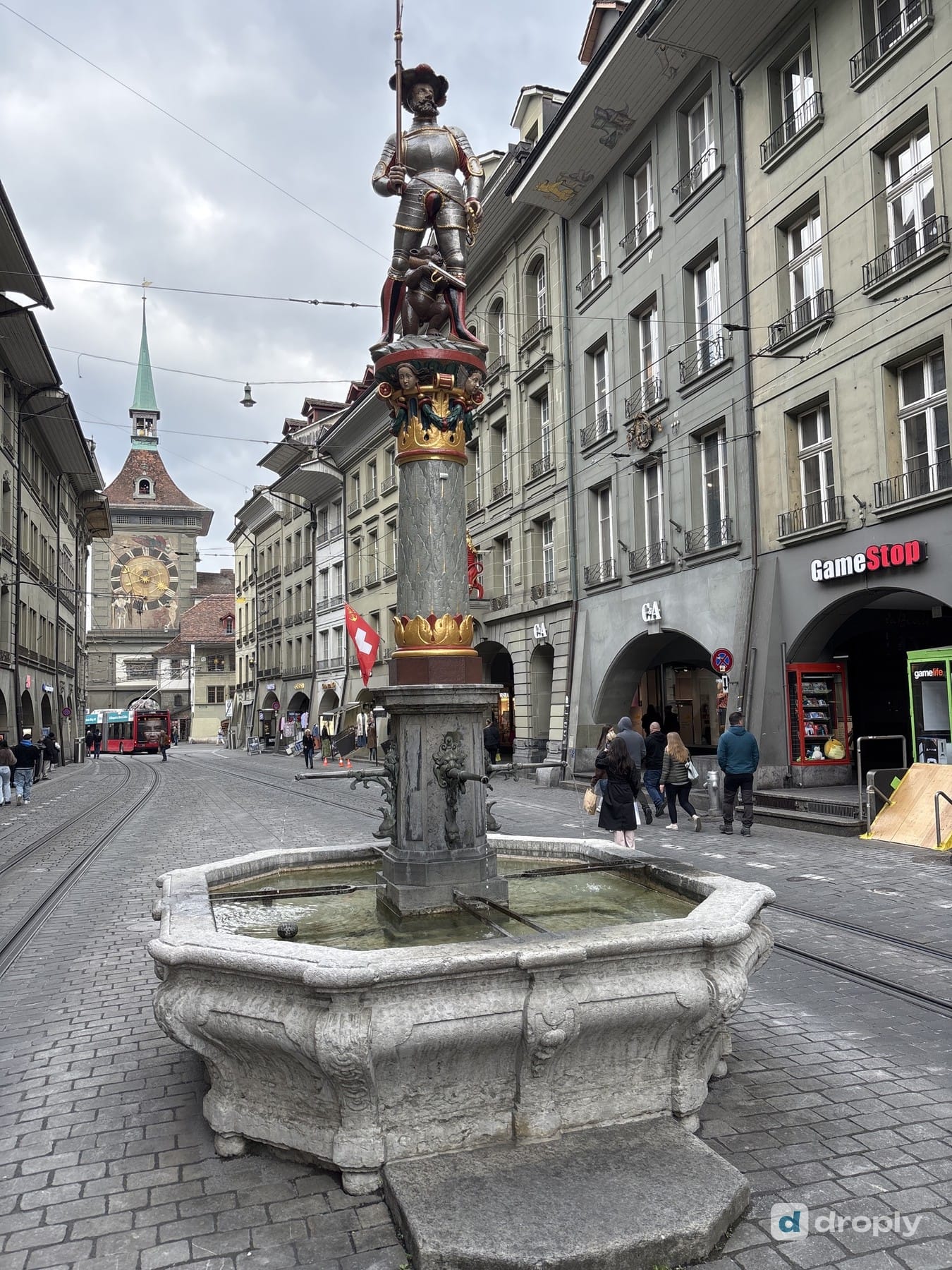
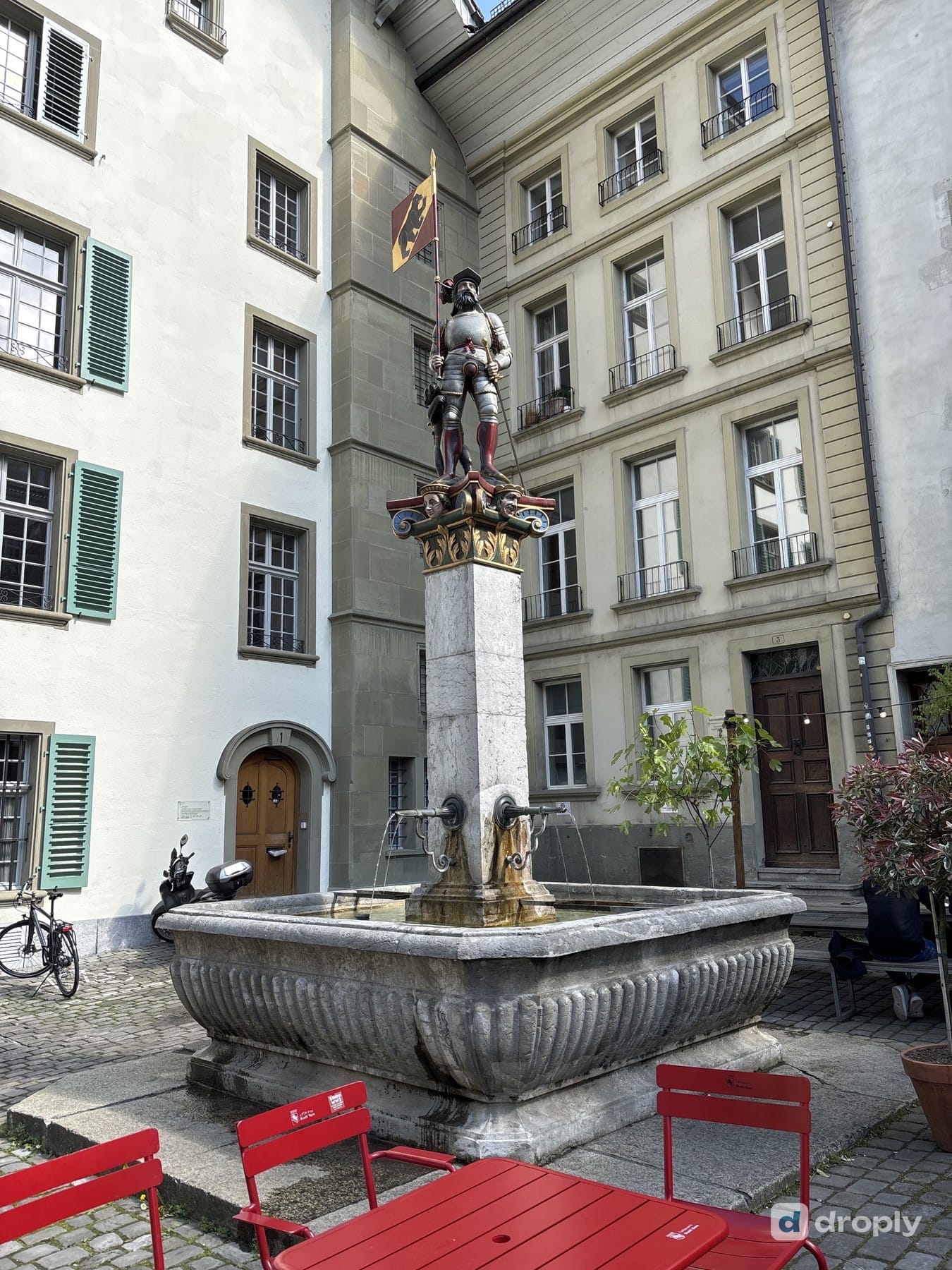
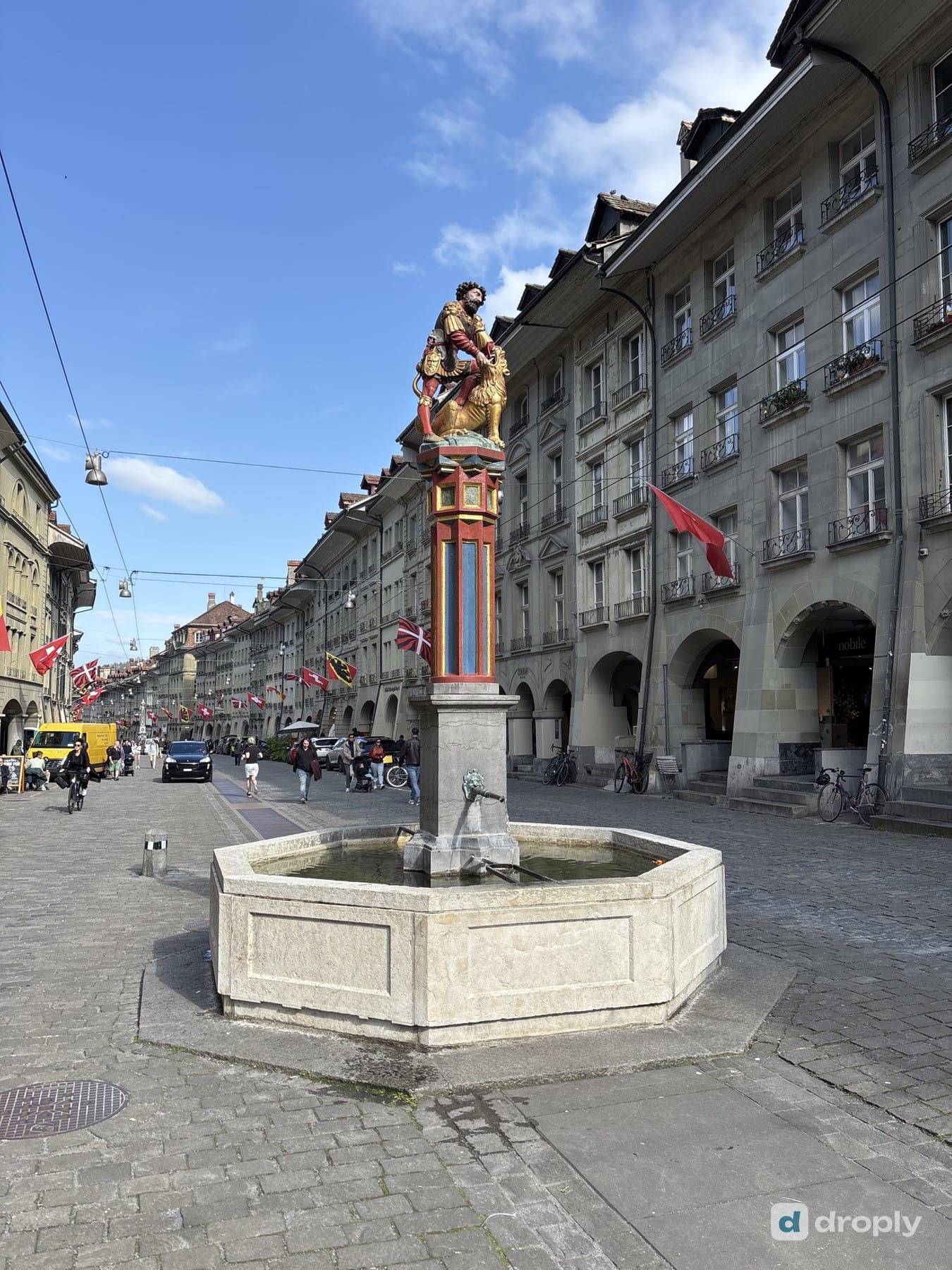
The decisive push came a good 150 years later. From 1520 the first stone fountain was built on Kreuzgasse, and between 1542 and 1546 Bern replaced almost all wooden fountains with stone ones with a figure on a column. Most of these figure fountains were made by the Fribourg sculptor Hans Gieng or his workshop. Eleven of them still stand today, many with copies in place of the originals, which are kept in the Bern Historical Museum.
If you want the history behind it and not only a refill, Bern Welcome offers the city tour All about water: a walk through the Lower Old Town to selected fountains and into the cellar of the State Chancellery to the Lenbrunnen, the oldest cistern of the city, which is otherwise not open to the public.
Summary: Bern planned its water supply from 1191 and between 1542 and 1546 replaced almost all wooden fountains with stone figure fountains, most of them from the workshop of Hans Gieng. Eleven still stand today.
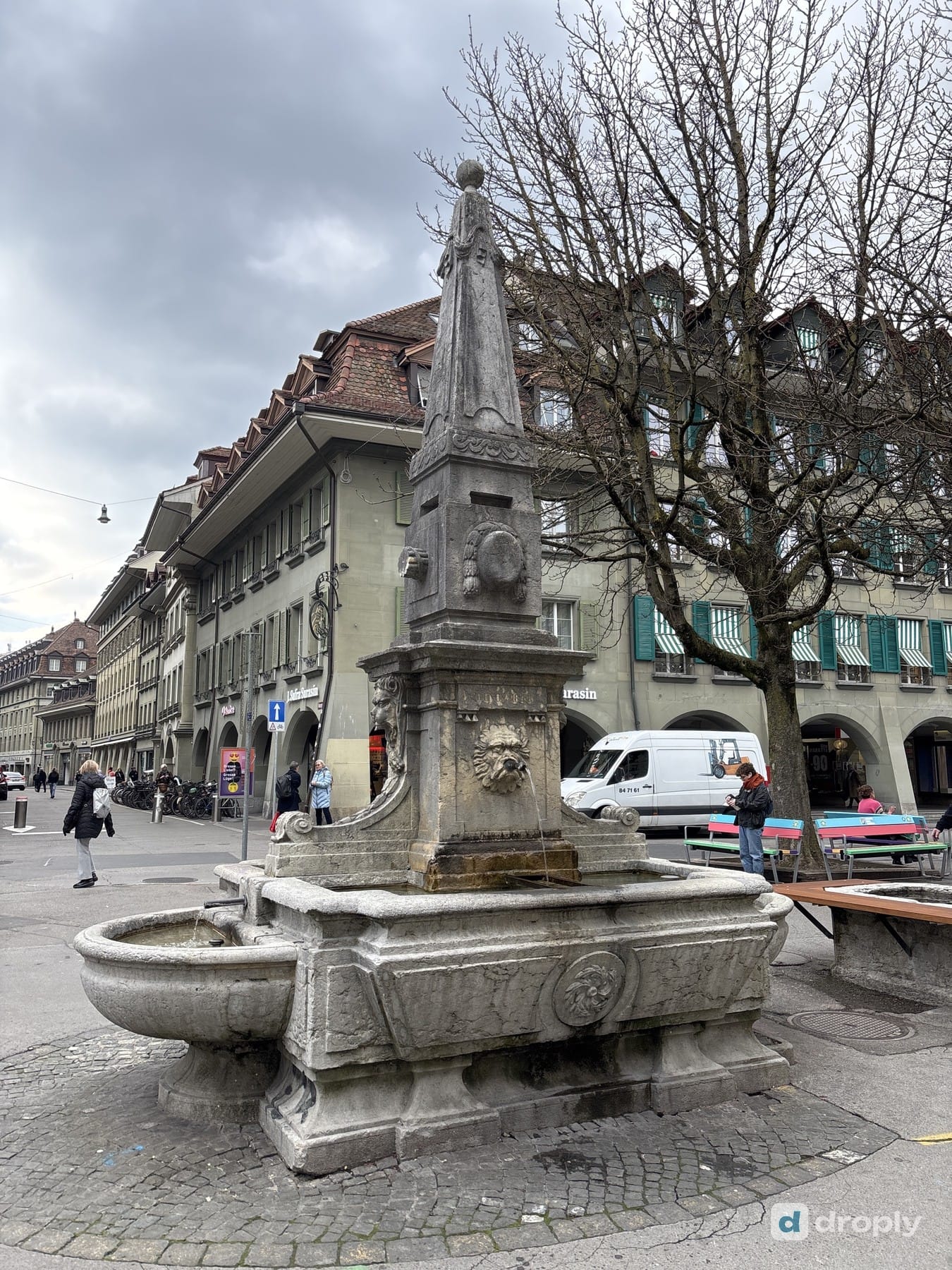
The four most important fountains in Bern and their stories
If you stop at only four fountains, stop at these. They all stand in the Old Town and together cover the full range: the founding of the city, the Reformation, the rule of law, and a figure nobody can explain to this day.
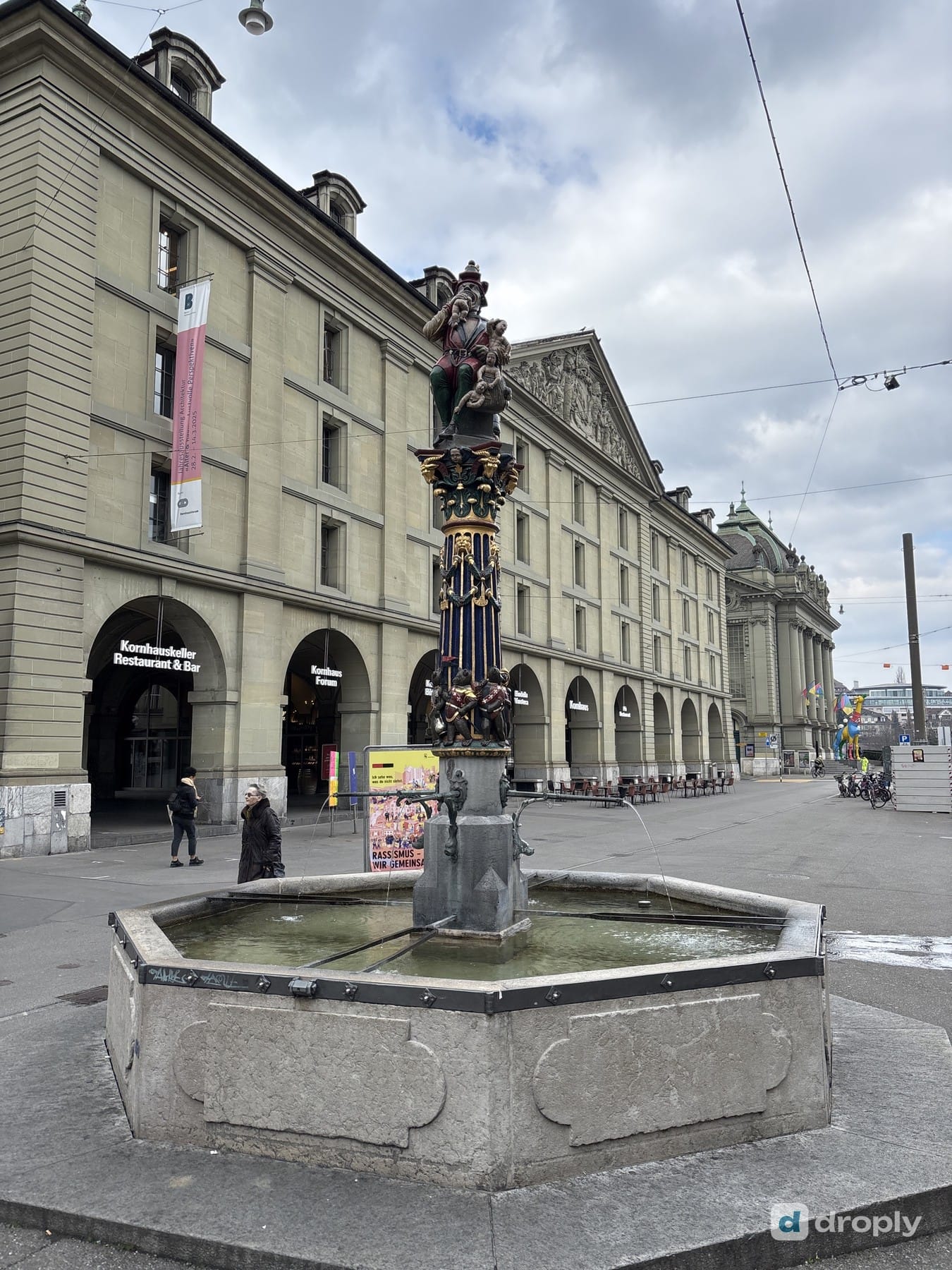
Kindlifresserbrunnen, Kornhausplatz
The best-known and most uncanny fountain of the city, built in 1545/46 to replace a wooden predecessor. The figure is a seated ogre eating a naked child, with more children in his sack. It was originally just called Platzbrunnen, the current name is documented only from 1666.
Hans Gieng left not a line about what the figure means and who ordered it. Accordingly many readings circulate: a carnival figure, the child-eating god Kronos, the brother of the city founder, or simply a scare figure for disobedient children. None of them is proven. The fountain runs and carries drinking water, even if most people stop in front of it to take photos rather than to refill.
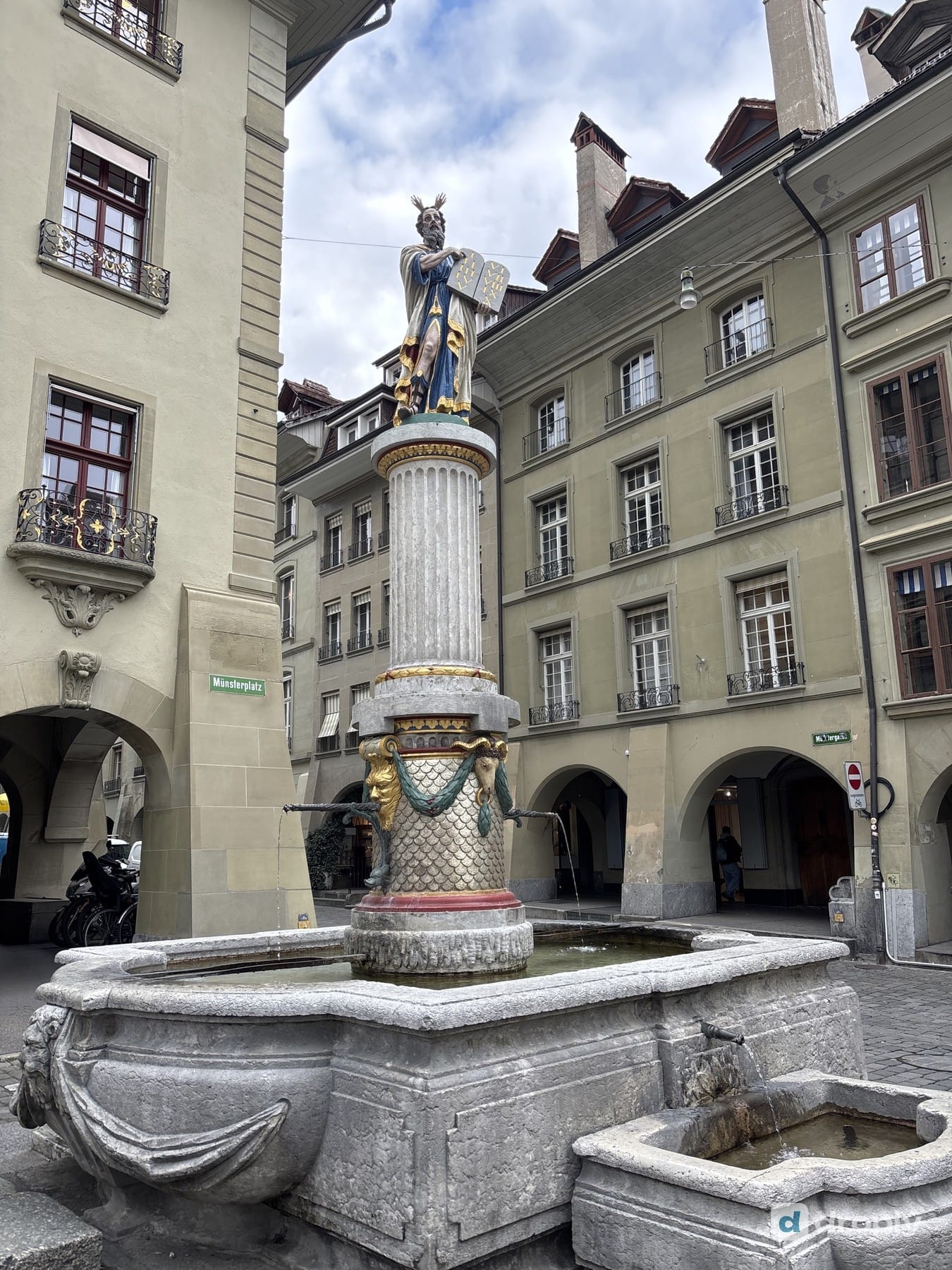
Mosesbrunnen, Münsterplatz
The Moses fountain stands directly in front of the Bern Minster and is a Reformation statement in stone. Moses holds the two tablets of the law in his left arm and points with his right hand at the second commandment, the ban on images. On the square in front of the largest church in the city, in a Bern that has been Protestant since 1528, this is no random gesture.
The current fountain is from 1791. Trough and column probably go back to Niklaus Sprüngli, the figure was made by Nikolaus Sporrer from Konstanz. A first Moses fountain stood here in 1544, its figure was so weathered by 1740 that it was removed.
Zähringerbrunnen, Kramgasse
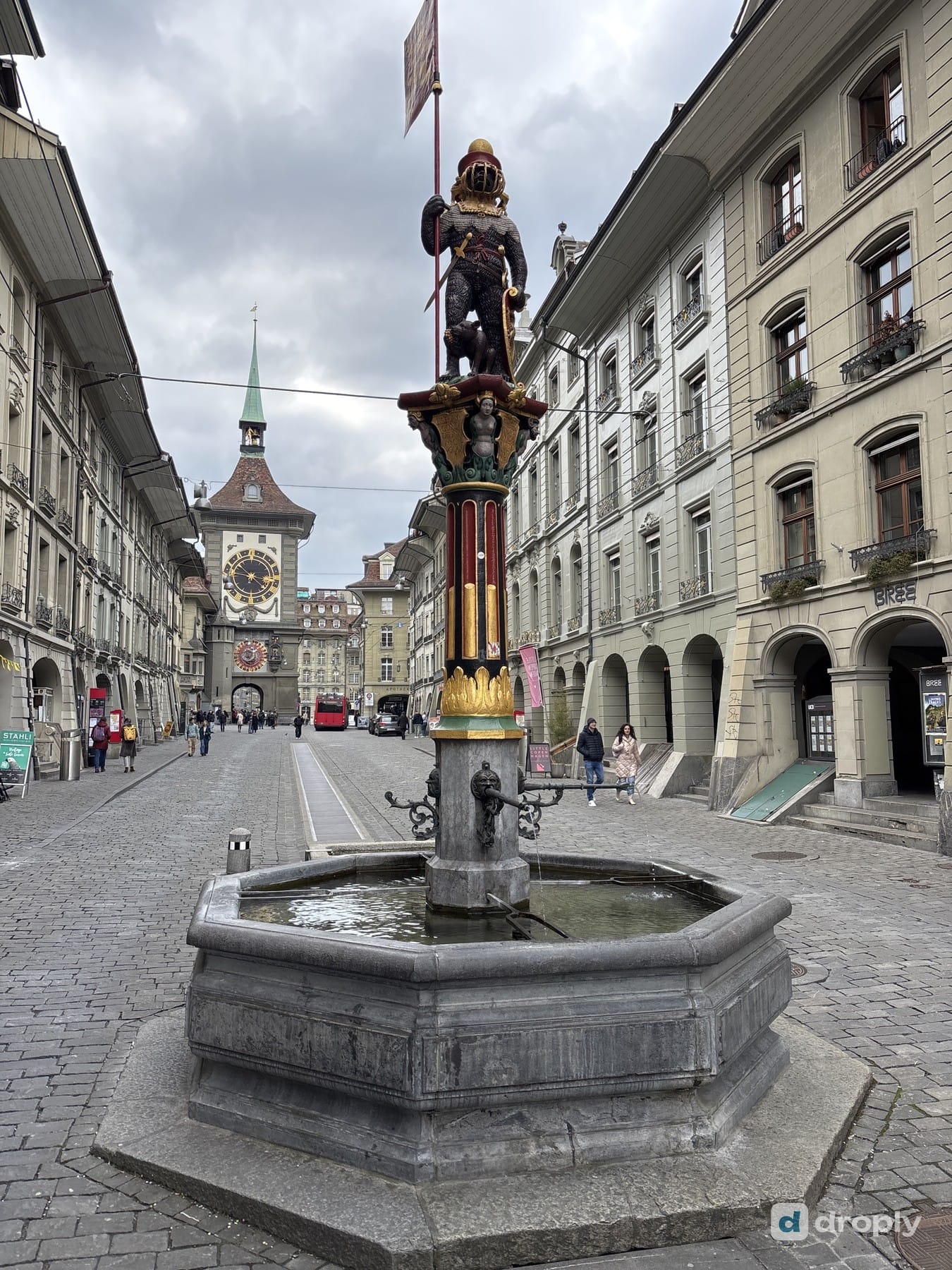
The founding legend of Bern as a fountain figure. On the column stands a bear in full armor, with the shield and banner of the Zähringer lion, and a bear cub at his feet. It stands for Berchtold V of Zähringen, who founded the city in 1191, and for the legend that he named the city after the first animal he killed: a bear, hence Bern.
The fountain was built in 1535, so it is older than the Gieng series, and was made by Hans Hiltprand. It stands on Kramgasse below the Zytglogge, which makes it a popular photo spot: tower and bear in one picture. Walking down Kramgasse, you quickly pass the next fountain.
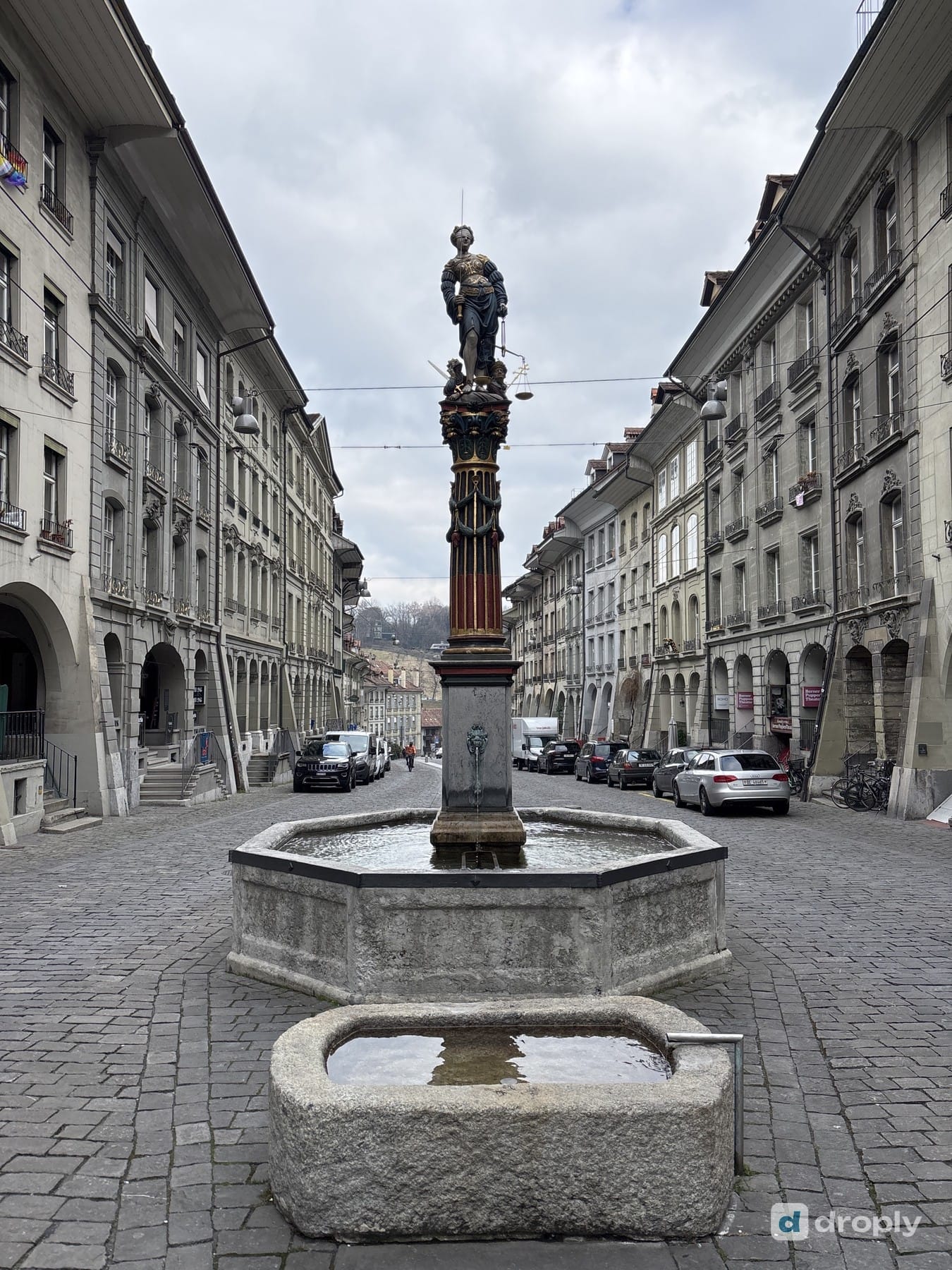
Gerechtigkeitsbrunnen, Gerechtigkeitsgasse
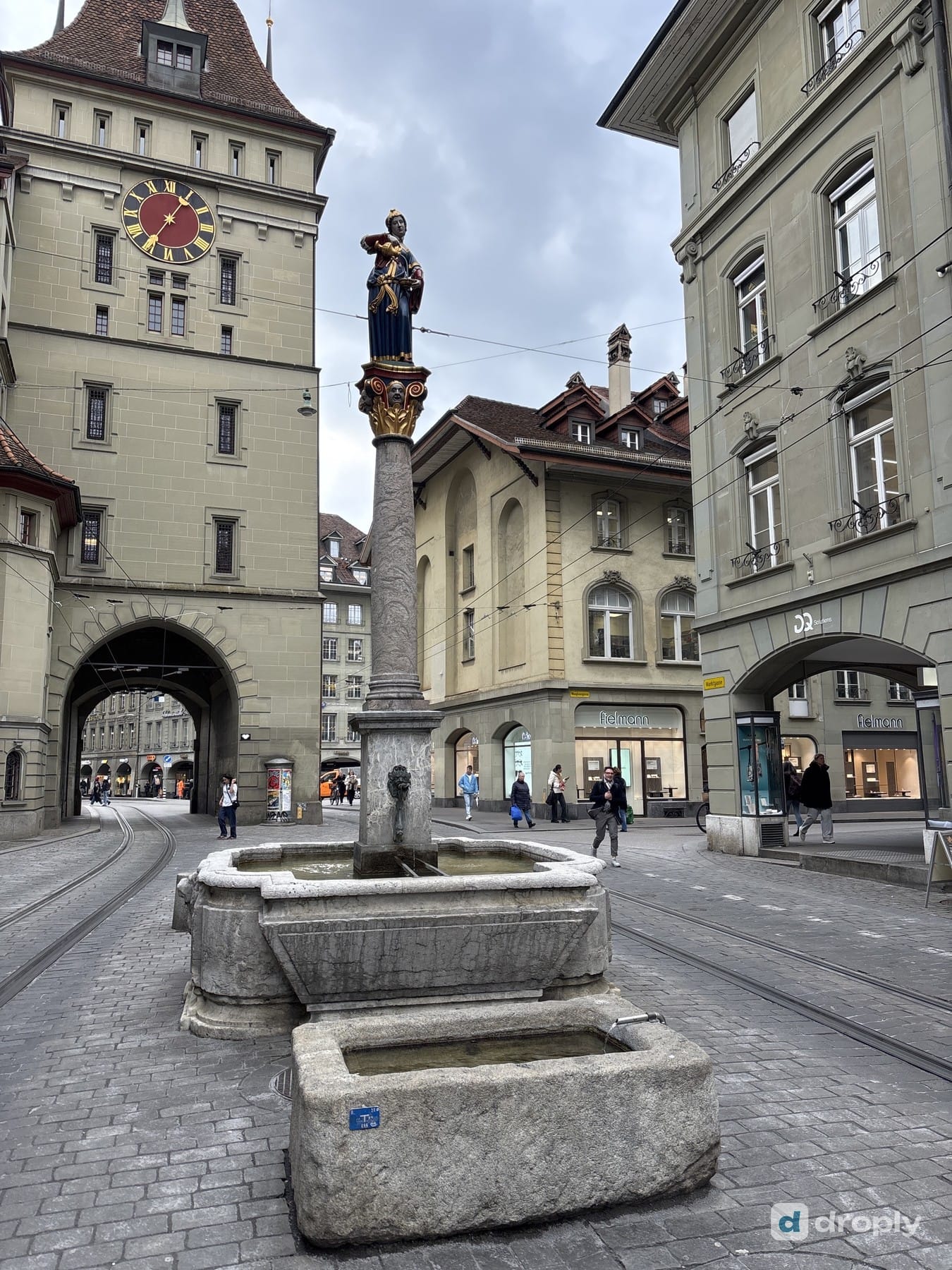
Justitia with sword and scales, and, unusual for 1543, with a blindfold. This blindfold later became the standard symbol of impartial justice, and here it is one of the early examples. At Justitia’s feet sit four busts of rulers with closed eyes: pope, emperor, sultan and Schultheiss, so theocracy, monarchy, autocracy and republic, all subordinate to justice.
On 13 October 1986 the figure was pulled down with a rope and tackle and badly damaged, attributed to the Jura separatist group Groupe Bélier. The original has been in the Bern Historical Museum since then, and a copy has stood on the column since 1988.
Summary: The Kindlifresser, Moses, Zähringer and Gerechtigkeit fountains all stand in the Old Town and together tell the founding, the Reformation and the legal understanding of Bern. All four carry drinking water.
The Glasbrunnen in the Bremgartenwald: an outing worth making
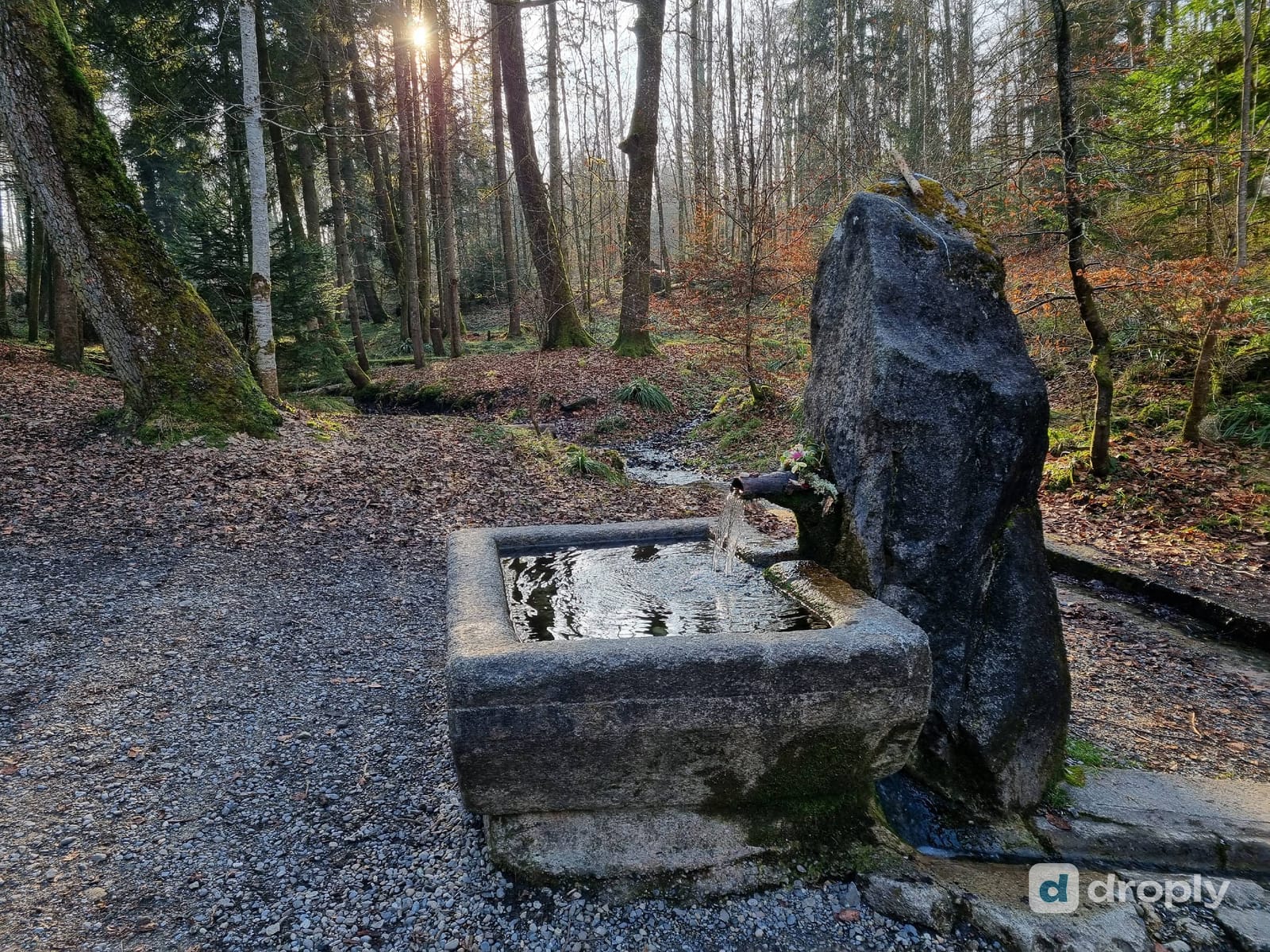
The Glasbrunnen is a captured forest spring in the Bremgartenwald north of the Neufeld district, at about 548 meters, on land of the Burgergemeinde Bern. A stone trough, a wooden pipe, a boulder next to it, and several forest paths that cross right there. In Bern the water was long considered especially good. In 2010 a blind test by the cantonal laboratory even confirmed that it could not be told apart from tap water.
Since then the picture has changed. The spring has been tested weekly since August 2020, and three to four times a year bacteria were found, mostly after heavy rain or thunderstorms. The reason lies in the catchment area: groundwater from the built-up area of Bümpliz-Bethlehem also flows into the spring, so chloride, nitrate and sulfate are high, and the spring reacts quickly to rain. That is why a sign at the fountain has said since May 2024 that the water should no longer be drunk.
As a destination the Glasbrunnen is still worth it: a quiet place in the middle of the forest, ideal for a walk from Neufeld or Bremgarten. Fill your bottle at an Old Town fountain beforehand. In droply the Glasbrunnen is listed, with the current note on drinkability.
The legends around the name are older than the problem. One tells of a man who made a garden with a crystal fountain for his beloved, she demanded a castle on top and in the end got nothing, and since then on some nights she has to draw water for passersby. Another traces the name to Magdalena Nägeli, daughter of the Bernese Schultheiss Hans Franz Nägeli. A third suspects a medieval glassworks or Celtic glass beads behind it.
Summary: The Glasbrunnen in the Bremgartenwald is worth an outing. Its water was long considered especially good, but since 2020 it was repeatedly contaminated, mostly after heavy rain, and should therefore no longer be drunk.
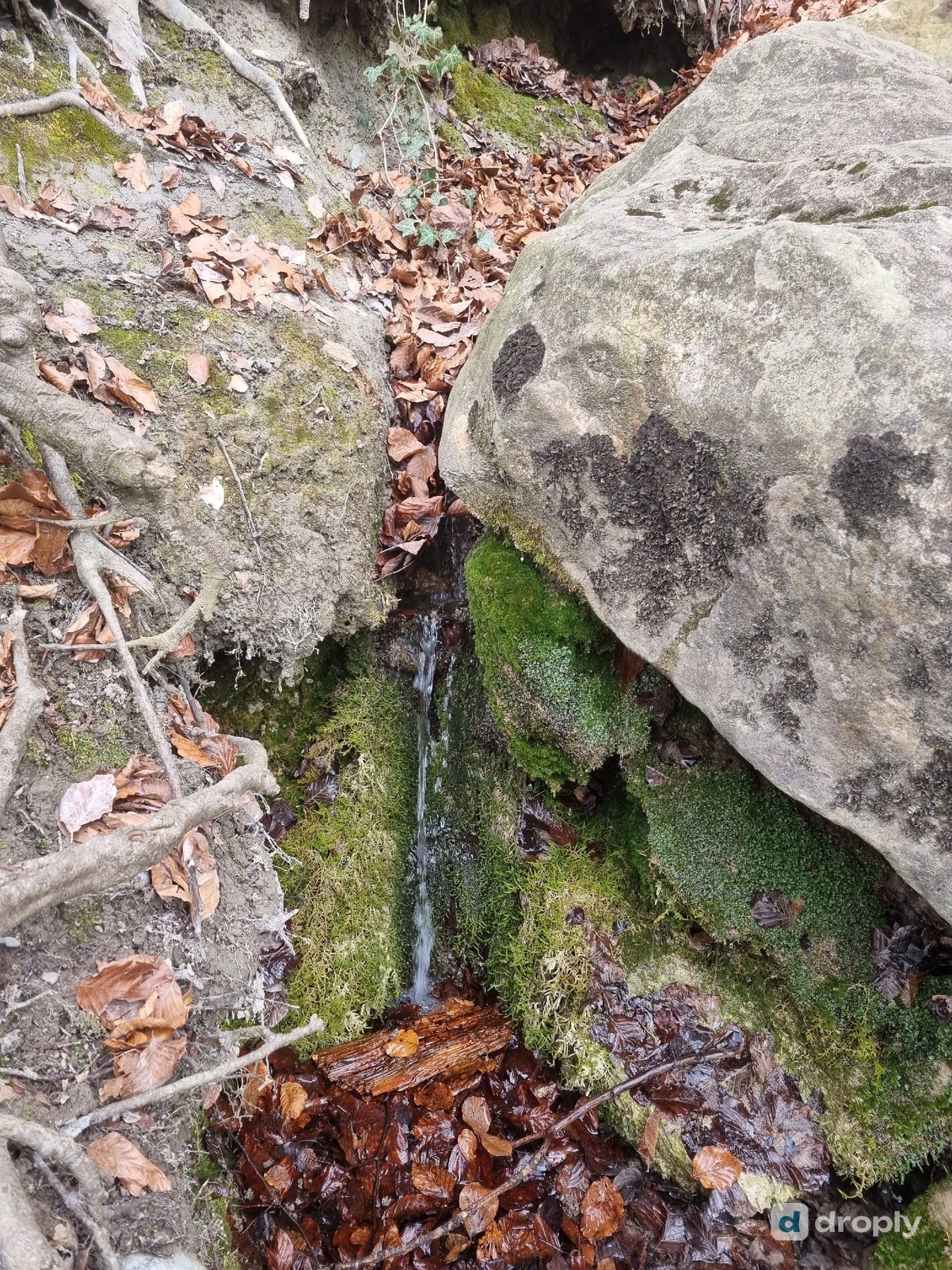
Where does the water in Bern’s fountains come from?
From groundwater, captured in the Emmental and in the Aare valley. A large part flows without pump power into the Mannenberg reservoir or to the Schönau pumping station, because the sources lie higher than the city. Energie Wasser Bern and Wasserverbund Region Bern AG together supply over 200,000 people around the clock this way.
The water needs no treatment. It is monitored continuously in the laboratory, plus an unusual biological early-warning system: bleak, small carp-family fish, swim in test tanks and react to changes in water quality before a routine analysis shows them.
Hardness is 20 to 30 French degrees depending on the supply area, so about 11 to 17 German degrees, which means medium hard to fairly hard. For drinking-water quality this does not matter, for your kettle it does. Why water tastes different depending on rock and time underground, we explain in a separate article.
Summary: Bern’s drinking water is untreated groundwater from the Emmental and the Aare valley, and most of it flows into the city by gravity. Hardness is 20 to 30 French degrees.
Can you drink from all fountains in Bern?
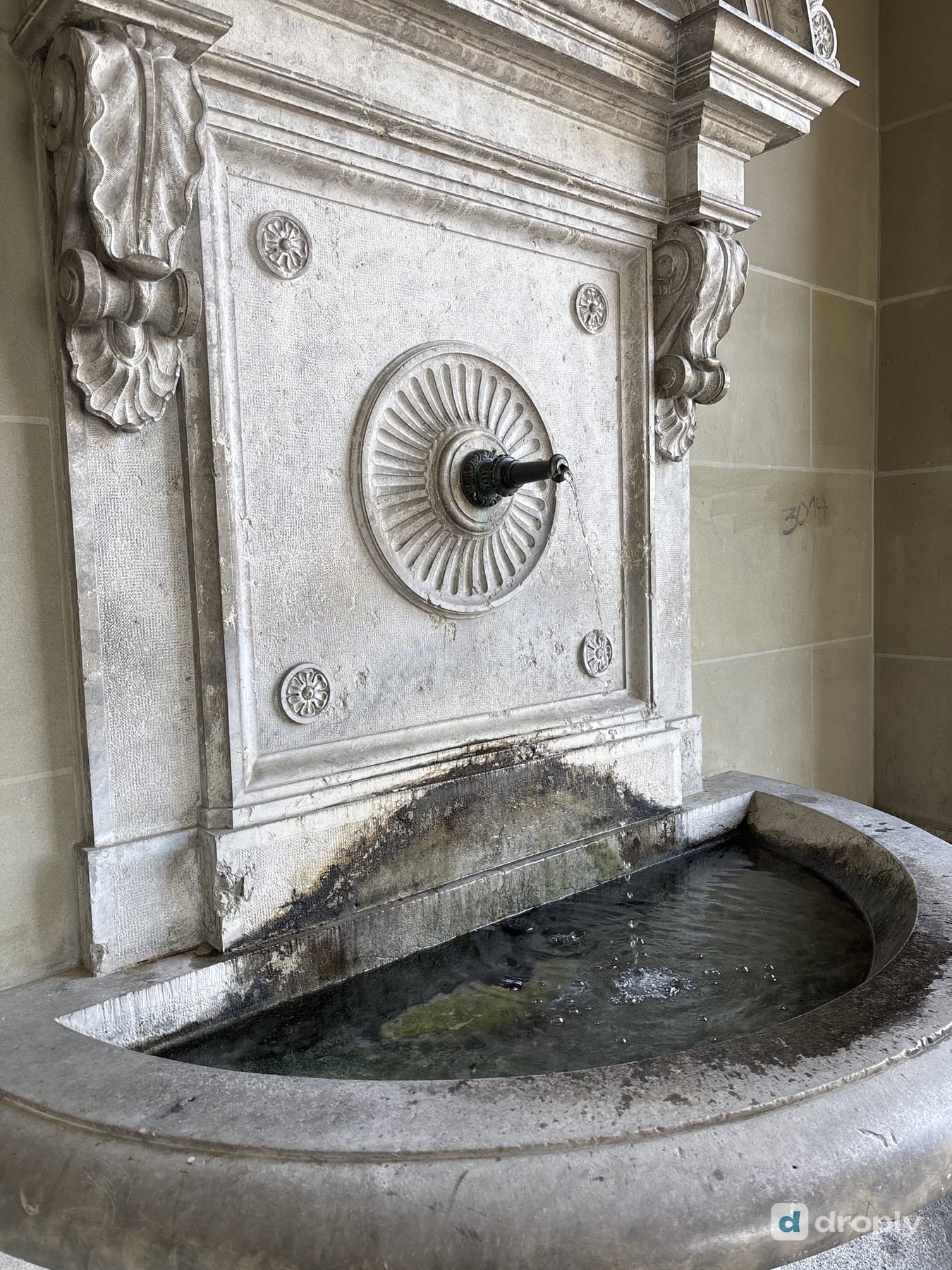
No, but from almost all. The 102 fountains maintained by Energie Wasser Bern carry normal Bern tap water and are cleaned weekly. Besides these there are three groups where you should look closer: purely decorative fountains and pond features without a spout to drink from, art fountains that were never meant as a water source, and some fountains in private hands that carry a “Kein Trinkwasser” sign.
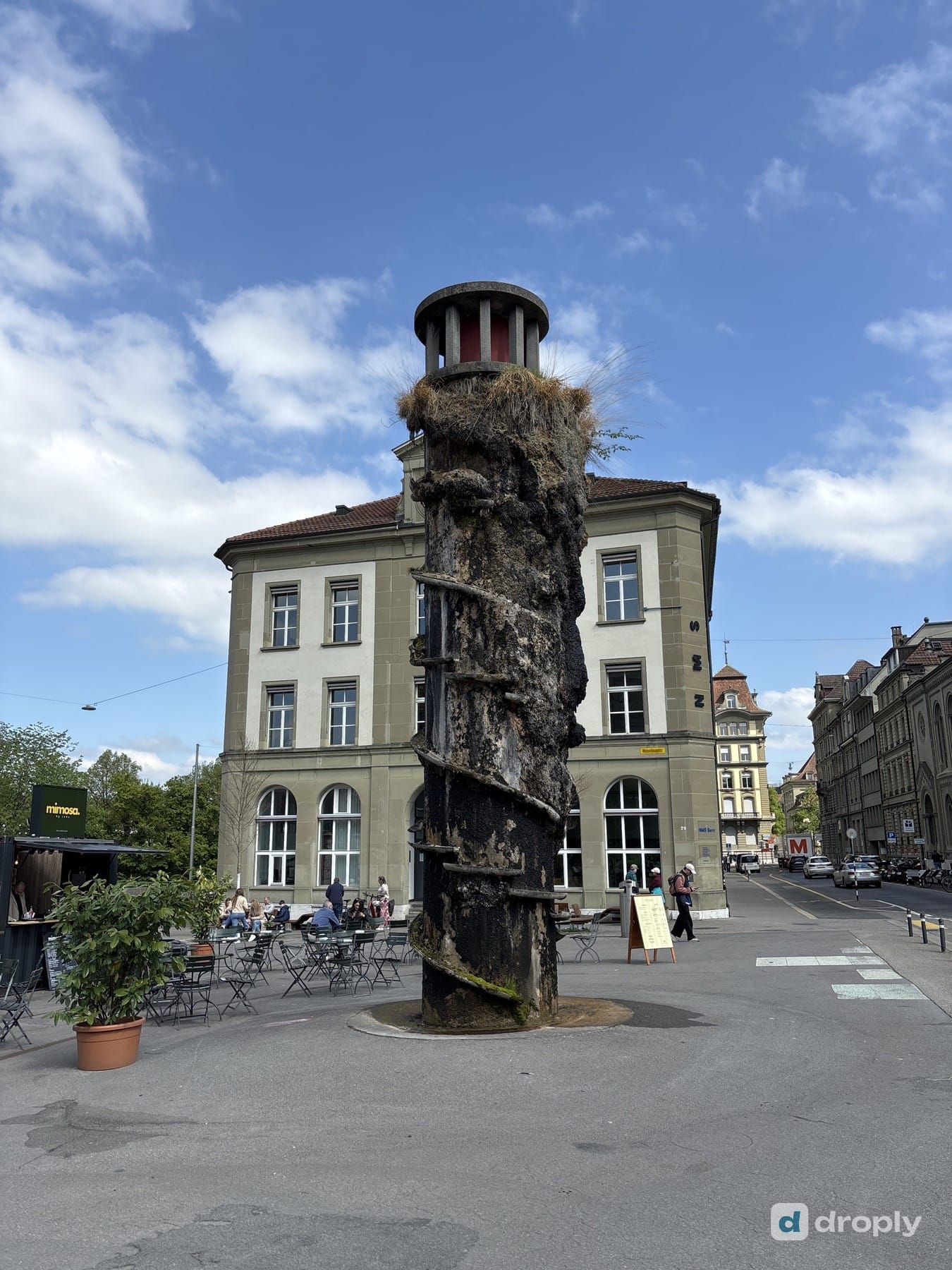
A good example of the second group stands on Waisenhausplatz: the Meret-Oppenheim-Brunnen from 1983, a concrete tower over which the water runs so that limescale, moss and plants settle on it. That is intended and part of the artwork, but it is not a water source.
At the Glasbrunnen the same applies for a different reason: the water is available there, but the sign says clearly no. That clear water from a forest spring is not automatically safe is true outside Bern too, more in our article on why filtered mountain water is not always safe.
Summary: The 102 fountains maintained by the city carry drinking water. Decorative fountains, art fountains and signed exceptions such as the Glasbrunnen do not.
Your own fountain tour with droply
The eleven historic figure fountains lie almost all on one axis, from Spitalgasse via Marktgasse and Kramgasse to Gerechtigkeitsgasse. It is a walk you can do in half a day, with photo stops and refills. You need no guide and no opening hours.
In droply you find the fountains on the map, and for most Bern fountains the story is there too: year of construction, figure, origin of the name. You tap the fountain in front of you and read what you are looking at, instead of learning a list beforehand. If you want to contribute, add a photo or report whether a fountain is running: that is exactly how the data grows.
Summary: The eleven figure fountains lie on one axis through the Old Town, a walk for half a day. In droply you see them on the map, most of them with the story behind them.
Drinking water on hikes around Bern
Plan a hike by water sources, not only by kilometers. Around Bern that means: in the city you regularly find fountains, and once you go deeper into the forests at the edge of town, for example the Bremgartenwald, it gets much thinner. And the most striking fountain in the forest, the Glasbrunnen, is no longer a water source.
For a planned route, load the GPX file into the droply Navigator, and the app searches for known water sources along the route. Before you start you see where you can refill reliably and where a longer dry section follows. How much water you need for which section depends on distance, temperature and pace, more in the guide to how much water to carry hiking.
Summary: In the city water is close, in the forest areas at the edge of town it is not. Load your route into the droply Navigator to see water sources and dry sections beforehand.
Is fountain water drinkable all over Switzerland?
In principle yes, and this goes far beyond Bern. In the practice of the cantons: if a publicly accessible fountain is not clearly signed “Kein Trinkwasser”, you can assume the water is drinkable. The municipality is responsible for operation and quality, and drinking water is among the most strictly controlled foods in Switzerland.
The Glasbrunnen shows that this system works: the spring was not silently kept running, it was tested, assessed and signed. How this looks in another Swiss city, with official fountain data and its own spring-water network, is in our guide to drinking water in Zurich.
Summary: Without a “Kein Trinkwasser” sign, a public Swiss fountain counts as drinkable. That is common municipal practice, not a single law, but reliable across the country.
Why droply works well in Bern
droply was built by two Swiss who know the Swiss outdoors first-hand. In Bern you see this in the depth of the data: for most fountains in the Old Town you find not only the location but also photos from the community and the story behind it. For a city where a fountain is rarely just a fountain, this is the difference between a map with dots and one that tells you what you are standing in front of. More on the background of the two founders is in our droply story.
Frequently asked questions
How many drinking-water fountains does Bern have?
droply lists about 250 fountains with drinking water in the Bern area, around 50 of them in the Old Town. Energie Wasser Bern maintains 102 fountains for the city, 36 of them in the center. On top of that come decorative and art fountains without drinking water, and fountains owned by others, for example the Burgergemeinde.
Can you drink from the fountains in Bern?
From the 102 fountains maintained by Energie Wasser Bern, yes: they carry normal Bern tap water and are cleaned weekly, without chemical additives. Exceptions are decorative and art fountains, and fountains with a Kein Trinkwasser sign. In droply you see the last known status of every listed fountain.
Where can I refill my water bottle in Bern?
At any running fountain in the center. In the Old Town between the train station and the Nydegg bridge you are usually only a few steps from a fountain, and along Spitalgasse, Marktgasse, Kramgasse and Gerechtigkeitsgasse one follows the next. It is free everywhere.
Why is Bern called the fountain capital?
Because Bern has an unusually high number of public fountains for a city of its size, and because eleven of them are among the best-known Renaissance figure fountains north of the Alps. They still stand at their historic locations in the Old Town, which has been a UNESCO World Heritage Site since 1983.
Where does the drinking water in Bern come from?
From groundwater in the Emmental and the Aare valley. A large part flows without pumps into the Mannenberg reservoir, because the sources lie higher than the city. The water needs no treatment and is monitored continuously, including with bleak (a small carp-family fish) in test tanks as a biological early-warning system.
How hard is the tap water in Bern?
Medium hard to fairly hard, depending on the supply area 20 to 30 French degrees, which is about 11 to 17 German degrees. That matters for your kettle and your coffee, not for drinking-water quality.
What is the Kindlifresserbrunnen and what does the figure mean?
A figure fountain from 1545/46 on Kornhausplatz, originally called Platzbrunnen. The figure is an ogre eating a child, with more children in his sack. Hans Gieng left no explanation, so several readings exist to this day, from a carnival figure to the god Kronos to a scare figure for children.
Why does the Moses fountain point at the second commandment?
Because Bern has been Protestant since 1528. Moses holds the tablets and points at the ban on images, on the Münsterplatz in front of the largest church in the city. The current fountain is from 1791, a first Moses fountain stood here as early as 1544.
What is the bear on the Zähringer fountain about?
The armored bear from 1535 recalls Berchtold V of Zähringen, the founder of Bern, and the legend that the city took its name from the first animal he hunted down. The bear carries a shield and a banner with the Zähringer lion, a bear cub sits at his feet.
Can I drink water at the Glasbrunnen in the Bremgartenwald?
Better not. The water was long considered especially good, but it has been tested weekly since August 2020 and was repeatedly contaminated, mostly after heavy rain. Since May 2024 a sign at the fountain says it should no longer be drunk. The place is still worth a visit, just fill your bottle at an Old Town fountain first.
Where is the Glasbrunnen and how do I get there?
In the Bremgartenwald north of the Neufeld district, at about 548 meters, on land of the Burgergemeinde Bern. You reach it on foot along forest paths, several of which cross right at the fountain.
Can I do a fountain tour of Bern on my own?
Yes. The eleven historic figure fountains lie on one axis from Spitalgasse to Gerechtigkeitsgasse, a walk for half a day. In droply you find the fountains on the map, and for most Bern fountains the story behind them too, so you can build your own route.
Is there a guided fountain tour in Bern?
Yes, Bern Welcome offers the city tour All about water. It leads through the Lower Old Town to selected fountains and into the cellar of the State Chancellery to the Lenbrunnen, the oldest cistern in the city, which is otherwise not open to the public.
How do I recognize a Swiss fountain without drinking water?
By the sign Kein Trinkwasser at the fountain. If there is no sign, the water counts as drinkable, which is common practice of the municipalities all over Switzerland. Purely decorative and art fountains you usually recognize because they have no spout to drink from.
How do I plan water for a hike around Bern?
Load your route as a GPX file into the droply Navigator. The app shows you the known water sources along the route and the dry sections in between. Around Bern, water is dense in the city and much thinner in the forest areas at the edge of town.
Published on
← Back to blog  By Micha · Co-Founder, droply
CDT thru-hiker (2024) · Co-founder of droply
Micha co-founded droply after thru-hiking the Continental Divide Trail in 2024. A former scout and lifelong outdoor enthusiast, he's always chasing water sources to map: hidden natural springs and hot springs are his favorites.
Get new posts in your reader
New guides and trail notes land in your feed reader the day they're published. No email address, no account, no tracking.
Feed address
https://droply-app.com/rss.xml